
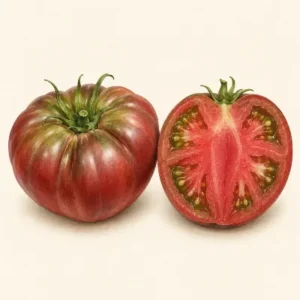
Rosella Purple Tomato
A Cherokee Purple-level flavor bred onto a compact three to four foot plant by more than a thousand volunteer gardeners in the open-source Dwarf Tomato Project, using nothing more than electric toothbrushes and patience.
Flavor & performance
The honest verdict
What's great
- Cherokee Purple-level flavor on a 3 to 4 ft plant
- Open-source seed, free for anyone to grow and save
- Sturdy central stem needs minimal staking
- Great choice for patios, balconies, and small beds
- Open-pollinated, so saved seed comes true
Watch out for
- No bred-in disease resistance
- Dusky color makes ripeness easy to misjudge at first
- Still needs steady watering to avoid splitting
- Fruit is medium, not a giant beefsteak
- Less widely available than mainstream hybrids
Grow it in your zone
| Trait | Rosella Purple Tomato | Cherokee Purple | Other dwarf tomatoes |
|---|---|---|---|
| Plant height | 3–4 ft | 6+ ft | 2–4 ft |
| Flavor | Rich, intense | Rich, intense | Often milder |
| Fruit size | 6–12 oz | 8–16 oz | Varies, often smaller |
| Days | 65–75 | 80–85 | Varies |
| Bred for | Flavor on a dwarf frame | Classic heirloom taste | Size or resistance |
| Save seeds | Yes | Yes | Varies |
Full size heirloom flavor bred onto a three foot plant
Most heirloom tomatoes ask for a lot of space. Tall, sprawling vines that need a six foot cage and a corner of the garden all to themselves, plus the patience to wait weeks longer for their complex flavor to develop.
The Rosella Purple tomato breaks that trade off. It packs a rich, complex flavor close to Cherokee Purple onto a plant that tops out at three to four feet.
That combination did not happen by accident. It is the product of a real breeding project. It was not run by a seed company, but by more than a thousand backyard gardeners working together.
This guide covers that story, what the tomato actually is, and how to grow it well. It is one of the best dwarf varieties available today.
What the Rosella Purple tomato actually is
This is a dwarf indeterminate tomato with medium to large fruit, roughly 6 to 12 ounces. It ripens to a striking dusky rose purple, with a rich crimson red interior.
Despite the name, it is not truly purple. The color sits closer to a deep dusky pink with darker shoulders. That puts it in the same family as Cherokee Purple and other so called black tomatoes, none of which are actually black either.
Growers new to these dark heirlooms are often surprised the first time they see one ripening.
The plant itself is the real story. It grows a thick, sturdy central stem and stays compact at three to four feet. Its dark, rugose leaves look distinctly different from a typical tomato plant.
Expect ripe fruit around 65 to 75 days from transplant. That is early for a tomato with this much flavor. The taste is balanced and intense, often compared directly to Cherokee Purple.
Bred by more than a thousand backyard gardeners
Here is what makes this tomato genuinely different from almost anything else on a seed rack. It was not developed in a corporate lab or a university program.
It came out of the Dwarf Tomato Project, a volunteer breeding effort started in 2005 by Craig LeHoullier and Patrina Nuske Small. The goal was simple. Keep the flavor and character of heirloom tomatoes, but shrink the plant to fit a patio or a small garden.
Over a thousand volunteer gardeners around the world took part. Each one grew, selected, and crossed plants using ordinary tools, including electric toothbrushes to collect and move pollen by hand.
Promising crosses were grown out for six to eight generations until the traits stabilized into a true, dependable variety. Rosella Purple was one of the results. It was selected from a cross tracing back to a small red dwarf called Budai Torpe and a full size heirloom called Stump of the World.
Free for anyone to grow, save, and improve
There is one more detail that sets this variety apart. The Dwarf Tomato Project pledged its seeds to the Open Source Seed Initiative.
That means Rosella Purple can never be patented or locked up by a single company. Anyone can grow it, save its seed, and even use it in their own breeding work. That is exactly what the original volunteers did.
For a tomato this good, that openness matters. It is a genuinely different model from the closed, patented hybrids that dominate a lot of modern seed catalogs.
So every packet of Rosella Purple you plant carries that history forward. You are not just growing a tomato, you are taking part in a small, ongoing act of shared plant breeding.
What it tastes like
This is where the project’s goal really pays off. The flavor is balanced and intense, carrying real acidity alongside a deep, savoury sweetness.
Growers who have tried both often compare it directly to Cherokee Purple, one of the most respected dark heirlooms around, and favourably at that. It is a serious compliment for a plant a fraction of the size.
The crimson flesh is juicy and meaty, with that classic rich depth found in the best dark tomatoes. It slices beautifully and holds its own in a caprese salad or piled onto a sandwich.
For a compact plant, that level of complexity is rare. Most dwarf and container tomatoes trade flavor for size, and this variety is one of the clearest exceptions to that rule.
The best ways to use it
This tomato shines brightest sliced fresh, where its rich crimson color and complex flavor need nothing more than a little salt and good olive oil. It is a natural match for a caprese salad, where its depth stands up well against fresh mozzarella and basil.
It also holds up well on a sandwich or burger, offering the same thick, meaty slice you would expect from a much bigger heirloom. The flesh is dense enough that it does not turn bread soggy the way a watery slicer might. That density is a direct result of the breeding project chasing genuine heirloom texture, not just heirloom looks.
Because it is so productive for its size, a couple of plants can supply enough fruit for cooking too. It makes a rich, dark sauce with a deeper, more savoury character than an ordinary red tomato, closer in style to the sauce you would get from a full sized black heirloom.
How to grow the Rosella Purple tomato, start to finish
Starting seeds
Start seeds indoors 6 to 8 weeks before your last frost. Sow a quarter inch deep in fresh seed starting mix, kept warm around 70 to 80°F.
Give strong light the moment they sprout so they stay stocky. Pot up at the first true leaves and feed at half strength.
Transplanting and spacing
Plant out after frost, once nights hold above 50°F. Harden the seedlings off over a week first, then bury two thirds of the stem for strong roots.
Space plants about 2 feet apart, or give each one its own large container. That thick central stem takes up less lateral room than a full size heirloom.
Soil and feeding
Grow it in rich, well drained soil at a pH near 6.2 to 6.8. Work compost and a balanced fertilizer into the planting hole, then feed lightly once fruit sets. Our guide to feeding tomatoes covers the timing.
This variety responds well to a feed with a little extra phosphorus and potassium once flowering begins. That combination supports strong fruit set on a compact frame.
Light and water
Give it full sun, at least 6 to 8 hours a day. Water deeply and evenly, aiming for 1 to 2 inches a week at the base.
Steady moisture matters as much here as on any full size heirloom. Splitting and blossom end rot follow the same uneven watering pattern. A soaker hose under mulch keeps the rhythm even.
Support and containers
The sturdy central stem needs less staking than a typical indeterminate vine, but a simple cage or single stake still helps once it is loaded with fruit. Our guide to supporting tomatoes covers the basics.
This is also a genuinely good container tomato. Use at least a 5 gallon pot, with 7 to 10 gallons giving the best results. Check it daily in hot weather, since containers dry out fast.
Grower's Picks for Rosella Purple
The gear that matters most for growing Rosella Purple well, so you can buy the right thing once.
Why this makes such a good patio or balcony tomato
A lot of gardeners who love heirloom flavor give up on it once space runs out. A six foot Cherokee Purple simply does not fit on a balcony or a small patio bed.
Rosella Purple solves that problem directly. Its sturdy, compact frame does the heavy lifting. You get a full size, deeply flavored fruit without needing a tall cage or a wide bed to support it.
That makes it a smart choice if you are downsizing your garden or moving to an apartment with a balcony. It also suits anyone who simply wants more variety in a small raised bed. You can fit two or three dwarf plants in roughly the footprint one sprawling heirloom vine would need.
It is also a forgiving choice for a first time heirloom grower. The compact size makes staking, watering, and general care noticeably easier to manage than a towering indeterminate vine loaded with fruit. There is simply less plant to wrangle, and less that can go wrong along the way.
Problems to watch
Splitting. Uneven watering cracks the fruit just as it would on a full size heirloom. Keep moisture steady and mulch well, and see our tomato problem guide.
Blossom end rot. A dark, sunken patch on the fruit bottom, driven by uneven watering. Fix the watering rhythm rather than reaching for sprays.
Early blight. Like most heirloom lineage plants, it has little bred in resistance. Give it airflow and strip spotted lower leaves, as our tomato disease guide explains.
Misjudging ripeness. The dusky color can confuse new growers. Wait until most of the fruit has turned deep crimson red and the shoulders lose their green before picking.
Harvest and storage
Pick each fruit once most of it has turned deep crimson red and the shoulders have lost their green tinge. A ripe fruit gives slightly to a gentle squeeze, much like any full size beefsteak.
If frost or a heavy storm threatens, fruit that is showing color will finish ripening perfectly well indoors on a counter. You lose very little flavor compared with letting it ripen fully on the vine.
Store ripe tomatoes at room temperature rather than in the fridge. Cold storage dulls the flavor and turns the flesh mealy, undoing a lot of what makes this variety worth growing in the first place. A bowl on the counter is all it needs.
Saving seeds
This is one of the easiest tomatoes to save seed from, and doing so carries real meaning. Rosella Purple is open pollinated, so saved seed grows true to type.
Scoop the seeds and gel from a ripe fruit into a jar with a little water. Ferment for 2 to 3 days, rinse, and dry them on a plate before storing.
This variety was released through the Open Source Seed Initiative. Saving and sharing your own seed is not just allowed here, it is the whole point of how it came to exist.
Rosella Purple vs Cherokee Purple vs other dwarf tomatoes
Against Cherokee Purple, the flavor comparison is the whole point. Cherokee Purple is a tall six foot heirloom. Rosella Purple delivers similar depth of flavor on a plant a third the size.
Against other dwarf tomatoes bred outside this project, the difference is usually flavor. Many compact varieties were bred mainly for size or disease resistance. Rosella Purple was bred specifically to chase full size heirloom taste.
My honest take is simple. If your garden or patio cannot fit a sprawling Cherokee Purple vine, this is the closest you will get to that flavor in a fraction of the space.
Our guide to growing tomatoes in pots covers the container basics.
The verdict
The Rosella Purple tomato is a genuine success story, both as a plant and as a piece of grassroots plant breeding. It hands you real, complex heirloom flavor on a compact frame any small garden or patio can handle.
Behind every fruit is a real community effort. More than a thousand gardeners patiently crossed and selected plants until this variety stabilized into something worth sharing freely with everyone.
Grow it for the flavor, and appreciate the story behind it while you are at it. Give it sun, steady water, and a little support. This small, sturdy plant delivers a genuinely excellent tomato in return.