
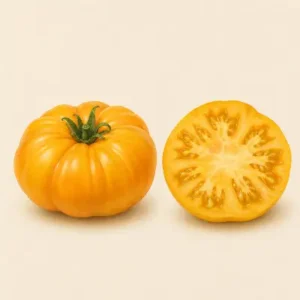
Dr. Wyche’s Yellow Tomato
A gold beefsteak from a circus owning founding seed saver who fed his mountain terraces with elephant manure, with flavor that earns the legend.
Flavor & performance
The honest verdict
What's great
- Cornell taste rating of 4.2, elite for a yellow
- Citrus edged sweetness growers rave about
- Crack resistant for a pound class beefsteak
- Documented history richer than any catalog tale
- Open pollinated, seed saves true
Watch out for
- Modest yield, sometimes a handful per plant
- Runs to 90 days despite shorter listings
- No disease resistance, fusarium reported
- Lumpy, ribbed, green shouldered fruit
- Too big and late for easy container growing
Grow it in your zone
| Trait | Dr. Wyche’s Yellow Tomato | Brandywine Yellow | Kellogg's Breakfast |
|---|---|---|---|
| Type | Heirloom, indeterminate | Heirloom, indeterminate | Heirloom, indeterminate |
| Color | Deep gold, orange blush | Golden orange | Deep orange |
| Days | 80–90 | 85–90 | 80–90 |
| Fruit size | 8 oz–1 lb | 1–2 lb | 1 lb+ |
| Flavor | Sweet, citrus edged | Intense, tart | Sweet, mild |
| Fruit finish | Smoother, crack resistant | Heavily ribbed, catfaced | Smooth, fragile |
| Save seeds | Yes | Yes | Yes |
The gardener on the rock mountain
Every heirloom catalog has one story it cannot resist, and this is it. A man in Hugo, Oklahoma grew tomatoes in 22 terraced gardens carved into a rock mountain, fertilized them with elephant manure from his own circus, and scattered lion and tiger waste around the edges to keep the deer away.
The Dr. Wyche’s Yellow tomato carries that story on every seed packet, and unlike most catalog legends, the core of it is documented. It comes from a memorial published by the Seed Savers Exchange itself in 1986, the year after John Wyche died.
Parts of the retold version still deserve a fact check, and one twist in how his tomato reached the world almost never gets told. This guide covers the man, the myth, the fruit, and how to grow a gold beefsteak worthy of the tale.
What the Dr. Wyche’s Yellow tomato actually is
This is a large yellow gold beefsteak, commonly 8 ounces to a pound, with growers reporting fruit past 20 ounces in good years. The shape runs flattened and lightly ribbed, ripening deep gold with an orange blush and often green shoulders.
The vine is indeterminate, sprawling 5 to 6 feet, on a main season clock. Listings say 80 to 87 days, and real gardens regularly report closer to 90, so plan patient.
Cornell’s citizen review database rates its taste at 4.2 out of 5, excellent for any beefsteak and outstanding for a yellow. The same reviewers score yield a modest 3.0, which is the honest trade this variety asks.
The man, as actually documented
John Wyche lived from 1911 to 1985 and gardened on a mountain of rock near Hugo, Oklahoma, where he built his terraced beds by hand. He was a founding member of the Seed Savers Exchange, present at the organization’s very beginning in the 1970s.
His generosity was the stuff of legend and record. He mailed out thousands of free seed packets every year to gardeners who asked, at his own expense.
The memorial records one more detail that outweighs the circus animals. Among his seeds were varieties his people, the Cherokee, carried over the Trail of Tears in the 1830s, kept alive in his family for well over a century. The famous Cherokee Trail of Tears pole bean entered the seed trade through him.
The circus fact check
Hugo, Oklahoma is not a random backdrop. The town is nicknamed Circus City USA, and the Oklahoma Historical Society records fifteen different circuses using it as winter quarters since 1942.
That context makes a circus owning gardener entirely plausible, and the elephant manure detail appears in the original memorial. But the retellings disagree on which circus, with one tradition naming Cole Brothers and another naming Carson and Barnes.
One more embellishment deserves flagging. The claim that Wyche was a dentist, repeated across catalogs, does not appear in the memorial at all.
So the honest version: a circus owning seed saver in America’s circus town fed his terraces with elephant manure. The specific circus, and the dental degree, remain unverified decoration.
The twist: this tomato arrived after he was gone
Here is the part of the story the packets skip. Wyche never listed this tomato himself, and its whole chain to him runs through one letter.
In 1992, seed arrived with Craig LeHoullier, the heirloom historian, from John D. Green of Tennessee, the same man whose earlier envelope had given the world Cherokee Purple. Green explained that Wyche had mailed him the seed shortly before his death in 1985, calling the variety Hot Yellow.
LeHoullier grew it out and listed it under the name it now carries, a memorial to the man rather than the name the man used. So the tomato honors Wyche, on the word of a friend, seven years after his death.
For gardeners who grow Cherokee Purple or Cherokee Green, there is a pleasing symmetry here. The same two men, Green and LeHoullier, stand behind this gold beefsteak too.
What it actually tastes like
Yellow beefsteaks carry a reputation for prettiness over flavor, and the Dr. Wyche’s Yellow tomato is a repeat exception. Growers describe it as sweet, rich, and complex, with one Cornell reviewer praising an orangey citrus note and another counting it among the most delicious varieties in the garden.
More than one experienced grower has called it the best yellow they have grown. The 4.2 taste score at Cornell backs the chorus with numbers.
The perceived mildness has a documented explanation. Purdue Extension notes that so called low acid tomatoes are just as acidic as red ones, with extra sugar doing the softening, which is exactly this fruit’s trick.
The record holds one honest dissent, a Michigan grower who found it very average. Cool, short seasons mute big yellows, and lateness plus a cold summer likely wrote that review.
What growers report from real seasons
The strengths first. One Virginia grower recorded the highest percentage of marketable fruit among the yellows in the garden, crediting strong crack resistance, unusual for a big soft beefsteak.
The costs follow. Yield runs modest, with one grower counting as few as four fruit per plant in a poor year, and the season runs long, with fruit often arriving weeks behind the listed dates.
Disease resistance is standard heirloom, meaning none. Fusarium and general late summer decline appear in reports, so airflow and rotation carry the defense.
The fruit itself comes lumpy, ribbed, and green shouldered, in the classic old beefsteak way. Growers who want supermarket uniformity are reading about the wrong tomato.
What elephant manure actually teaches
The circus fertilizer makes a great story, and it also contains a real gardening lesson. Wyche was feeding thin mountain soil with massive amounts of composted organic matter, which is the entire secret of terraced rock gardening.
The principle scales to any yard. Big beefsteaks like this one perform on soil built deep with compost and well rotted manure, whatever animal supplied it.
Extension guidance adds the safety rails. Iowa State recommends composted rather than fresh manure, applied at least 120 days before harvest for crops touching the soil, which conveniently matches fall application for spring planting.
No elephants are required. A few bags of composted manure worked in each fall honors the method, if not the showmanship.
The best ways to use it
Slicing is the calling. A single gold slab covers a sandwich, and the citrus edged sweetness plays beautifully against salt, bacon, and mayonnaise.
A BLT built on this fruit converts yellow tomato skeptics on the spot. The sweetness reads as ripeness rather than novelty, which is the whole trick of a great gold beefsteak.
The color earns its keep on a mixed plate beside red and purple varieties. Guests reach for the gold slices first, every time.
The sweet, meaty flesh also makes a striking golden salsa and a mellow, apricot colored sauce. And oversized ribbed fruit that will not win beauty contests cooks down without complaint.
How to grow the Dr. Wyche’s Yellow tomato, start to finish
Starting seeds
Start seeds indoors 6 to 8 weeks before your last frost. Sow a quarter inch deep in fresh seed starting mix, kept warm around 70 to 80°F.
Give strong light the moment they sprout so they stay stocky. Pot up at the first true leaves and feed at half strength.
Transplanting and spacing
Plant out after frost, once nights hold above 50°F. Harden the seedlings off over a week first, then bury two thirds of the stem for strong roots.
Space plants about 3 feet apart. A sprawling 6 foot vine carrying pound fruit wants elbow room and airflow.
Soil and feeding
Grow it in rich, deeply amended soil at a pH near 6.2 to 6.8, the closest thing to Wyche’s terraces you can manage. Work in generous compost or well rotted manure the season before, then a balanced fertilizer at planting. Our guide to feeding tomatoes covers the timing.
Feed lightly once fruit sets. A late, big fruited vine repays steady nutrition over surges.
Light and water
Give it full sun, at least 6 to 8 hours a day. Water deeply and evenly, aiming for 1 to 2 inches a week at the base.
Steady moisture matters through the long ripening stretch, when a pound of fruit is slowly filling. Our guide to watering tomatoes covers the rhythm.
Support
Plan for serious support from planting day. A stout stake or heavy duty cage anchored deep handles the sprawl and the weight. Our guide to supporting tomato plants lays out the options.
Growing in containers
A late, big, sprawling heirloom is a demanding pot resident. If you try, use a 20 gallon container with a tall cage, and guard the watering rhythm closely in heat.
Grower's Picks for Dr. Wyche’s Yellow
The gear that matters most for growing Dr. Wyche’s Yellow well, so you can buy the right thing once.
Problems to watch
The long wait. Real seasons run toward 90 days. Start strong seedlings, plant on time, and give it your warmest spot in short season country.
Modest yield. A handful of huge fruit per plant is normal. Plant two if the harvest matters, and see our tomato problem guide if fruit set stalls.
Standard heirloom disease exposure. Fusarium and late summer decline show up in reports. Rotate beds, mulch, water at the base, and watch our tomato disease guide signs.
Green shoulders and ribbing. Cosmetic and normal for the type. Judge ripeness by the deepening gold below the shoulders and by feel.
Harvest and storage
Pick when the body glows deep gold with an orange flush and the flesh gives gently, ignoring shoulders that stay stubbornly green. Support each fruit as you cut, since a pound of ripe beefsteak bruises under its own weight.
Eat ripe fruit within a few days at room temperature. Big soft yellows hold no reserve for the refrigerator.
If frost threatens the late crop, fruit showing any gold finishes indoors. Given the modest count, every one is worth rescuing.
Saving seeds
Dr. Wyche’s Yellow is open pollinated and grows true from saved seed. Saving it also continues one of the great seed sharing legacies in American gardening.
The man behind it mailed free seed to strangers by the thousand. Scooping, fermenting, and drying a jar of seeds from your best fruit, then passing an envelope to a neighbor, is the most fitting tribute this variety can receive.
Ferment seeds and gel in water 2 to 3 days, rinse, dry on a plate, and label. His bean crossed the Trail of Tears in a family’s keeping, and his tomato can cross generations in yours.
Dr. Wyche’s Yellow vs Brandywine Yellow vs Kellogg’s Breakfast
Against Brandywine Yellow, the other big gold with a famous name, the trade is temperament. Brandywine Yellow runs tarter and lumpier with legendary catfacing, while this one runs sweeter, smoother edged, and more crack resistant.
Against Kellogg’s Breakfast, the orange giant, the contest is closest. Kellogg’s brings bigger fruit and its own taste test pedigree, while the Dr. Wyche’s Yellow tomato brings the citrus edge and the better story by a country mile.
My honest take is simple. All three reward patience with a gold slice worth the season, so let flavor notes and storytelling settle it. Only one comes with elephants.
The verdict
The Dr. Wyche’s Yellow tomato is that rare heirloom whose legend checks out where it counts. The mountain terraces, the founding seed saver, the elephant manure, and the Cherokee family seeds are documented history, and the fruit lives up to the billing with top shelf yellow flavor.
Its price is patience. A long season, a modest count of enormous fruit, and standard heirloom fragility come with the gold.
Grow it if you want a beefsteak with a soul and a story you will retell at every summer table. Then save the seed and give some away, because that, more than the elephants, is what the man on the rock mountain was actually about.