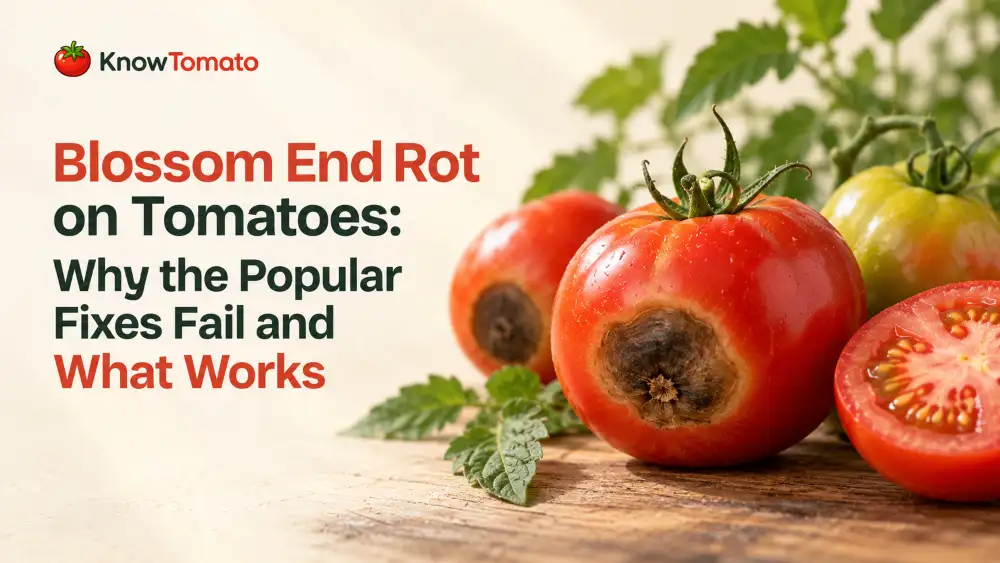
Your first tomatoes of the season are swelling, and then you turn one over. The bottom is sunken, leathery, and turning black.
That’s blossom end rot, and here’s the first thing to know. It’s not a disease, nothing is eating your plant, and it doesn’t spread.
Here’s the second thing, and it’s the one that saves you money. Almost everything the internet tells you to do about it, eggshells, Tums, milk, calcium sprays, epsom salt, either does nothing or makes it worse.
This guide explains what’s actually happening inside the fruit, puts each famous remedy on trial, and ends with the boring routine that really prevents it. Mostly, it involves your watering can.
What’s actually happening inside the fruit
Blossom end rot is a calcium problem, but almost never a calcium shortage. Missouri extension horticulturists make the point with a construction metaphor: calcium is the mortar between the bricks of plant cells.
Without it, cell walls at the fastest growing point collapse. That point is the bottom tip of the fruit, the end farthest from the stem. The tissue dies, sinks, and turns dark.
Now the twist. Soil tests on affected gardens usually find plenty of calcium sitting right there in the soil.
The problem is delivery. Calcium only moves through the plant dissolved in water, riding the transpiration stream, and it moves toward the parts pulling the most water.
Leaves pull hard. Fruit barely pulls at all.
So anything that interrupts water flow interrupts calcium delivery to the fruit tip. A drought weekend, a flooded week, roots cut by a hoe, a heat wave. The soil can be rich and the fruit still starves.
That’s why blossom end rot is called a physiological disorder rather than a disease. It sits alongside cracking and catfacing in our tomato fruit problem guide. And it’s why every remedy that adds more calcium to a soil that already has plenty is aiming at the wrong target.
The remedy tribunal
Time to put the folk fixes on trial, one by one. Each has believers, and each fails for a specific, explainable reason.
Eggshells in the planting hole is the most beloved ritual. Minnesota extension soil scientists looked at it directly: eggshells decompose far too slowly to supply calcium the season you need it. Gardeners who dig up last year’s holes find the shells intact, sometimes years later.
Tums in the soil is the strangest one, taught by one of the most popular gardening sites on the internet. A soil scientist ran the numbers on antacid tablets as a calcium source, and meaningful correction would take hundreds of tablets per plant. As delivered, a tablet or two is a rounding error wearing a mint flavor.
Calcium sprays are the one that sounds most scientific. Clemson’s factsheet addresses the myth head on: calcium doesn’t move from leaves to fruit, so spraying foliage can’t fix the fruit. Sprayed directly on young fruit, very little penetrates, and the disorder starts inside the tissue you can’t reach.
Milk watered in gets the same verdict by mechanism. The calcium in milk is real, but it lands in soil that already has calcium. Delivery, not supply, was the problem all along.
And epsom salt earns the harshest ruling. It contains no calcium at all, and magnesium competes with calcium for root uptake.
North Dakota extension is blunt: it doesn’t prevent blossom end rot, it leads to more of it. Our epsom salt investigation has the full story.
Why everyone swears their fix worked
Here’s the puzzle. If all these remedies fail, why does every comment section overflow with people who tried one and watched the rot stop?
Because early season blossom end rot usually stops on its own. Extension pathologists note the disorder concentrates in the first fruit clusters, when root systems are small and the weather swings hard.
As roots deepen and conditions settle, later fruit comes in clean. It’s a coincidence engine. Whatever you sprinkled in week one gets the credit for a recovery that was already coming, and the remedy earns a testimonial.
That’s worth remembering before you buy anything. The rot stopping is the expected outcome, with or without the eggshells.
Which plants get it worst
Blossom end rot doesn’t strike randomly, and knowing the risk list explains a lot of heartbreak. Paste and plum types like Roma and San Marzano are famously prone, and long elongated fruits suffer most because the tip sits farthest from the water supply.
Container plants are the other big victims. Pots dry out and rewater in sharp cycles, exactly the delivery interruption the fruit can’t handle. Our container growing guide covers how to smooth those swings.
First fruits on any plant carry extra risk, as do plants pushed hard with nitrogen early on. Fast lush growth means leaves outcompeting fruit for calcium.
And cherry tomatoes are nearly immune. If your slicers have black bottoms while the Sun Golds next to them are flawless, that’s not luck. Small fruit is easy to supply.
What actually prevents it
The real fix list is short, free, and unglamorous. Steady water leads it.
Aim for 1 to 1.5 inches a week including rain, delivered deeply and evenly instead of in feast and famine cycles. Our watering guide covers the rhythm, and it matters more than any product.
Mulch is the second tool. Two or three inches of straw or shredded leaves buffers soil moisture between waterings, which is exactly the steadiness the calcium stream needs.
Then come the don’ts. Don’t overdo nitrogen, especially early, and go easy on potassium and magnesium, since all of them compete with or outrun calcium. Our fertilizing guide covers balanced feeding.
Don’t cultivate deeply near the stem, because chopped feeder roots interrupt delivery for weeks. And don’t lime the soil unless a soil test says calcium or pH is actually low. Most garden soils don’t need it.
One more practical note. Affected fruit is not ruined. Cut away the dark end and the rest is fine to eat, and removing badly hit fruit lets the plant supply the next cluster better.
The honest asterisk
One thing worth knowing, because we’d rather tell you than have you find it in a comment war. A 2014 review in Scientia Horticulturae questioned whether calcium shortage is the root cause at all, suggesting cell membranes damaged by growth stress may fail first, with low calcium as a symptom.
The debate continues in the research world. What doesn’t change is the practical advice. Every camp agrees the trigger is growth stress and uneven water, and steady moisture prevents the disorder no matter which mechanism wins.
So the watering can stays the hero either way. Science may rewrite the middle of the story, but the beginning and the end are settled.
Frequently asked questions
How do I get rid of blossom end rot on my tomatoes?
You can’t cure affected fruit, so remove it and fix the conditions. Water deeply and evenly, mulch, and avoid heavy nitrogen. Later clusters usually come in clean once moisture steadies.
Can I eat tomatoes with blossom end rot?
Yes. Cut away the dark leathery end and eat the rest if it looks and smells normal. The disorder isn’t a disease and nothing about it harms you.
Do Tums or eggshells fix blossom end rot?
No. Eggshells decompose too slowly to matter this season, and a Tums tablet is a trivial calcium dose. Most soils already have enough calcium, since the real problem is watering that interrupts delivery.
Does calcium spray work on blossom end rot?
No. Calcium can’t move from leaves into fruit, and sprays barely penetrate the fruit itself. University factsheets list foliar calcium as a myth.
Why do only my Roma tomatoes get blossom end rot?
Paste and elongated varieties are the most susceptible because the fruit tip sits farthest from the water stream that carries calcium. Cherry types are nearly immune. Steady watering and mulch protect the prone varieties.