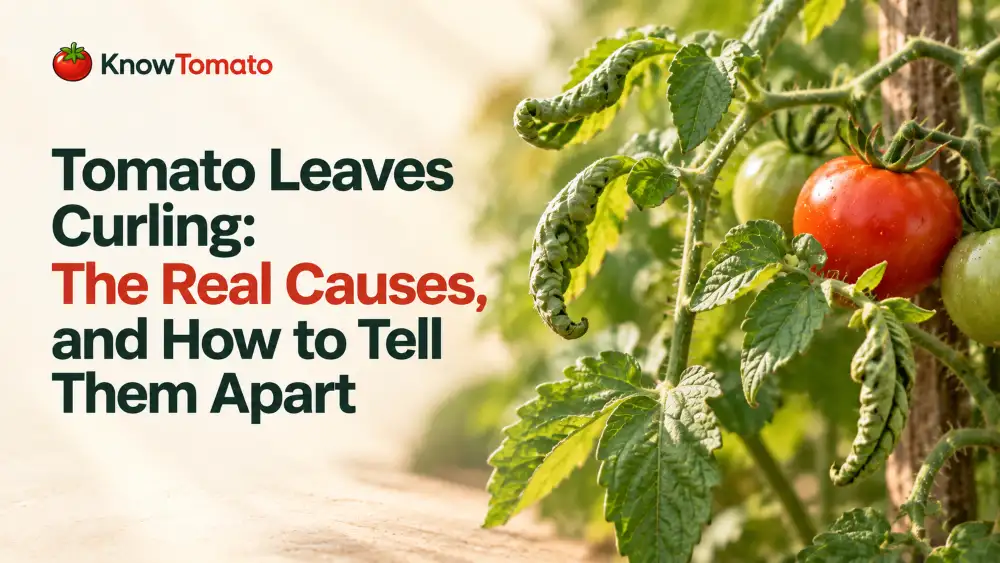
Tomato leaves curling sends most gardeners straight into panic mode. That reaction is usually unnecessary.
Most curling traces back to a harmless stress response that fixes itself. A smaller share traces back to something serious, and getting that distinction wrong wastes real time.
This guide covers all three real causes. It also covers a hidden source of curling that has nothing to do with weather or watering at all.
The short version
Most tomato leaves curling comes from heat, drought, or heavy pruning. The name for it is physiological leaf roll, and it rarely hurts yield.
A smaller number of cases come from viral disease spread by whiteflies, or from herbicide exposure. Both look more severe and need a different response entirely.
One herbicide source surprises almost everyone. Contaminated compost or manure can cause the exact same twisted leaves as a direct chemical spray, months after the fact.
The harmless cause: physiological leaf roll
Clemson Cooperative Extension lists a long set of common triggers for this condition. Excess moisture, too much nitrogen, not enough phosphorus, heat, drought, severe pruning, and transplant shock all qualify.
The pattern is distinctive once you know what to look for. Rolling starts on lower leaves first, with an upward cupping motion that becomes an inward roll toward the center vein.
Purdue University’s Vegetable Crops Hotline frames this as a defense mechanism. Leaves curl to reduce their exposed surface area during hot, dry stretches.
The good news outweighs the bad here. Clemson Cooperative Extension states plainly that this condition has minimal impact on tomato fruit production.
Indeterminate varieties show this more often than determinate ones. The curling typically resolves on its own once the stress passes.
The serious cause: viral leaf curl
Viral leaf curl looks similar at first glance, but the details give it away. Texas A&M’s Aggie Horticulture identifies geminiviruses, spread by whiteflies, as the main viral culprit behind tomato leaf curling.
Tomato yellow leaf curl virus ranks as the most common version, according to Aggie Horticulture’s Texas research. The symptoms: pale green, cupped new leaves, along with stunted growth and yellowing edges.
That detail matters more than it sounds. Physiological leaf roll hits older, lower leaves first, while viral curl targets new growth right away.
The disease usually keeps progressing too. Aggie Horticulture notes it often develops into a yellow green mosaic pattern across the leaves, a symptom physiological stress never produces.
There is no home fix for a viral infection. Removing the affected plant and controlling the whitefly population are the only real options.
The herbicide cause, part one: direct drift
Tomatoes react to herbicide exposure more dramatically than almost any other garden vegetable. Aggie Horticulture notes tomatoes are extremely sensitive to phenoxy type herbicides like 2,4-D and dicamba.
The threshold is remarkably low. Injury can occur at concentrations as low as 0.1 parts per million, according to Aggie Horticulture.
Symptoms look distinct from ordinary stress curling. Look for downward rolling, twisted growth, and in severe cases, split stems.
Recovery depends entirely on the dose received. Aggie Horticulture notes that a light exposure allows some recovery, but yield will still suffer either way.
Heavier exposure does not recover at all. There is no remedy once serious herbicide damage sets in.
The herbicide cause, part two: the compost nobody suspects
This is the source most gardeners never think to check. Aggie Horticulture explains that herbicide residue can reach tomatoes through compost or mulch made from hay treated with aminopyralid.
That chemical does not break down quickly. It can persist for 18 months in treated hay and hay products.
Gardeners on a permies.com forum thread traced a real case back to this exact source. They identified picloram, clopyralid, and aminopyralid as the likely chemicals, all known to stay chemically stable through the composting process.
The contamination path runs through livestock, not just hay directly. Manure from cattle that grazed herbicide treated pasture can carry the same residue into a garden’s compost pile.
The sensitivity numbers are striking. Forum participants cited plant injury occurring at concentrations as low as 1 to 3 parts per billion, with nightshades like tomatoes and eggplant especially vulnerable.
Recovery takes real patience once contaminated soil is identified. One experienced gardener on that thread estimated 2 to 3 years before affected soil produces normal growth again.
How to actually tell these apart
Start with which leaves are affected first. Lower, older leaves point toward physiological stress, while new growth at the top points toward virus or herbicide.
Look at the shape of the curl next. An inward roll toward the center vein suggests physiological stress, while a twisted, downward curl suggests herbicide exposure.
Check for other symptoms too. Yellowing edges, stunted growth, or a mosaic pattern point toward viral infection rather than a stress response.
Recent history matters as much as symptoms. New compost, new mulch, or nearby herbicide spraying all raise suspicion of chemical contamination over ordinary stress.
Frequently asked questions
Why are my tomato leaves curling upward?
Upward curling toward the center vein is usually physiological leaf roll, caused by heat, drought, or heavy pruning. It rarely affects fruit production and often resolves on its own.
Is curling always a sign of disease?
No. Most cases trace back to ordinary environmental stress rather than disease, though viral infections and herbicide exposure do cause more severe curling.
Can compost cause tomato leaves to curl?
Yes, if it contains residue from aminopyralid treated hay or manure from livestock that grazed treated pasture. That residue can persist for well over a year.
How do I know if it is herbicide damage instead of stress?
Herbicide damage tends to twist leaves downward, sometimes splitting stems, and hits new growth hardest. Physiological stress usually starts on lower leaves with a gentler upward curl.
Should I remove a tomato plant with curling leaves?
Only if you suspect viral infection, since there is no cure for that. Physiological curling and most herbicide exposure do not require removing the plant.
The bottom line: tomato leaves curling is usually harmless physiological stress that fixes itself. The exceptions, viral infection and herbicide exposure, look different enough to identify once you know what to check.
For the wider range of leaf symptoms this guide does not cover, see our tomato leaf problems guide. For identifying the whiteflies and other pests behind viral spread, see our tomato pests guide.
SOURCES
Clemson Cooperative Extension, Home and Garden Information Center: Tomato Leaves Rolling? https://hgic.clemson.edu/factsheet/tomato-leaves-rolling/
Purdue University, Vegetable Crops Hotline: Tomato Leaf Curling. https://vegcropshotline.org/article/tomato-leaf-curling/
Texas A&M AgriLife Extension, Aggie Horticulture: What Makes Tomato Leaves Twist or Curl? https://aggie-horticulture.tamu.edu/wp-content/uploads/sites/10/2013/09/EHT-064.pdf