
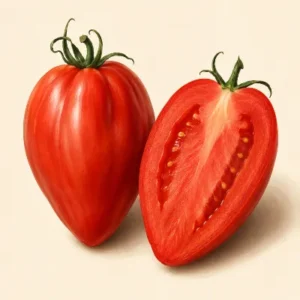
Amish Paste Tomato
The heirloom that broke the paste-tomato rules: big, meaty oxheart fruit that cooks into a deep, sweet sauce and is still good enough to slice fresh.
Flavor & performance
The honest verdict
What's great
- Big, meaty fruit with real flavor
- Sweeter and richer than most paste types
- Doubles as a fresh slicer, rare for a paste
- Heirloom, so you can save the seed
- Keeps producing all season long
Watch out for
- Tall vine, needs staking and space
- Prone to blossom end rot and cracking
- Sparse leaves can let fruit sunscald
- Little disease resistance
- Size and shape vary fruit to fruit
Grow it in your zone
| Trait | Amish Paste Tomato | San Marzano | Roma |
|---|---|---|---|
| Fruit size | 6–12 oz | 3–4 oz | 2–3 oz |
| Shape | Oxheart / plum | Long, narrow plum | Small plum |
| Plant habit | Indeterminate | Indeterminate | Determinate |
| Days | 80–85 | ~80 | ~75 |
| Flavor | Sweet, rich, versatile | Classic, drier, intense | Mild, workmanlike |
| Best for | Sauce + fresh eating | Traditional sauce | High-yield sauce, small space |
| Disease resistance | Low | Low | Better |
Why gardeners keep coming back to Amish Paste
Ask a room full of serious sauce makers to name one paste tomato worth growing. I’d bet money Amish Paste comes up first.
Not Roma. Not even San Marzano.
Here’s why that keeps happening. Amish Paste breaks the biggest rule of paste tomatoes: it actually tastes good fresh. Most paste types are dry, bland little bricks you’d never slice onto a sandwich. This one has real sweetness with enough acid behind it to taste like a proper tomato.
The trade is that it’s juicier than a classic paste type. And that one fact changes how you should cook with it, which I’ll get into below.
It’s an heirloom, and it’s open pollinated. It’s even earned a spot on Slow Food’s Ark of Taste, a catalog of heritage foods worth protecting. Big fruit, twelve ounces is common, on a vine that keeps producing until frost.
The strange double history of this tomato
Most heirlooms have one origin story. Amish Paste has two, and I find that genuinely interesting.
The variety traces back to the 1870s and an Amish community around Medford, Wisconsin. That’s the accepted starting point. But it reached the wider world through Lancaster County, Pennsylvania, the heart of Amish country. A seedsman named Tom Hauch picked it up from Amish growers there.
It stayed a community tomato for over a century. National distribution only came in 1987, through the Seed Savers network.
So for a hundred plus years, this tomato lived in at least two separate Amish communities, hundreds of miles apart. Each saved its own seed, year after year.
Keep that in mind. Because I think it explains the number one thing that confuses people who grow it.
Why your Amish Paste tomatoes are different shapes (and why that’s fine)
Grow a few plants and you’ll notice something odd. Some fruit comes out like a big plum. Some looks like a small oxheart, that teardrop shape with a point at the bottom. Sometimes both shapes show up on the same plant.
New growers see this and worry they got bad seed. You didn’t.
Shape variation from plum to oxheart is documented as normal for this variety. And here’s my take on why. A tomato that spent a century being seed saved by hand was never squeezed through the uniformity filter of commercial breeding. Different strains are circulating, and none of them is “wrong.”
So judge your fruit by weight and feel, not by shape. Six to twelve ounces, dense and heavy in the hand, ripening to a deep glowing red. That’s Amish Paste doing its thing.
The juicy paste problem, and how to cook around it
Time for the honest part. Compared to Roma or San Marzano, Amish Paste carries more juice and more seeds. Purists will tell you that makes it a worse paste tomato.
They’re half right.
Straight off the stove, a pot of chopped Amish Paste throws off more liquid than a pot of San Marzano. If you just simmer and hope, your sauce takes longer to thicken. That’s the real complaint behind most negative reviews of this variety, and it’s fair.
But you can flip it. Three ways I’d handle it:
Roast instead of boil. Halve the fruit, roast it cut side up until the edges caramelize, then blend. The oven drives off the water and concentrates the sugars at the same time. Roasted Amish Paste sauce is where this variety embarrasses the competition.
Drain the free liquid. Chop the fruit, salt it lightly, and let it sit in a colander for half an hour before cooking. You lose water, not flavor.
Or just simmer longer and enjoy it. That extra juice carries the acid and sweetness that make the finished sauce taste alive instead of flat. There’s a reason growers who run side by side sauce tests keep ranking it at or near the top for finished flavor.
One more trick I picked up from longtime canners: some of them toss a handful of sweet cherry tomatoes into every batch of Amish Paste sauce to push the sweetness up another notch. Worth trying once your Sungold plant starts overproducing, which it will.
And don’t overlook the peeling math. Big fruit means fewer tomatoes to skin per quart of sauce. Peeling forty San Marzanos or fifteen Amish Paste for the same pot? I know which afternoon I’d rather have.
How to grow Amish Paste, start to finish
This is a tall, vigorous, indeterminate heirloom, and it wants the full season treatment. Here’s the whole routine.
Starting seeds
Start seeds indoors 6 to 8 weeks before your last frost date. Sow them a quarter inch deep in a quality seed starting mix, not garden soil, which is too heavy for tiny roots.
Keep the soil around 70 to 80°F for germination, and expect sprouts in about a week. Once they’re up, they need strong light immediately or they’ll stretch into leggy, floppy seedlings.
Pot them up into bigger containers when the first true leaves appear. Feed lightly, half strength, once a week.
Transplanting
Wait until nights stay reliably above 50°F and the soil has warmed. Cold soil stalls tomatoes for weeks, and Amish Paste needs its 80 to 85 days, so a stalled start matters.
Harden the seedlings off for a week first, a few more hours outside each day.
Then plant them deep. Strip the lower leaves and bury two thirds of the stem. Tomatoes grow roots along any buried stem, and a bigger root system is exactly what a heavy yielding vine like this needs. It’s the single best free upgrade you can give it.
Space plants 24 to 36 inches apart. Crowding an indeterminate heirloom is asking for disease.
Soil
Rich, well drained, slightly acidic. A pH between 6.2 and 6.8 is the sweet spot.
Work a few inches of compost into the bed before planting. If you’ve had blossom end rot before, it’s worth running a simple soil test first, because the fix depends on what your soil actually holds. More on that below.
Light
Full sun, 6 to 8 hours minimum, and more is better. Fruit quality and yield both track sunlight directly.
One caveat that’s specific to this variety: the foliage is naturally sparse, so the fruit already gets plenty of sun exposure. You don’t need to prune for light, and as you’ll see, you mostly shouldn’t.
Water
Deep and even is the whole game. About 1 to 2 inches a week, delivered at the base of the plant, not on the leaves.
A soaker hose or a simple drip line makes consistency almost automatic, and consistency is exactly what prevents the two big paste tomato problems, cracking and blossom end rot. Top it with a few inches of straw mulch to hold moisture steady and keep soil off the lower leaves.
Swinging between bone dry and soaked is the worst thing you can do to this plant. Our full guide to growing tomatoes from seed to harvest covers the watering rhythm in more detail.
Feeding
At planting, mix a balanced organic fertilizer into the hole. Once the first flowers show, switch to a tomato feed that’s lower in nitrogen and higher in phosphorus and potassium.
Why the switch matters: nitrogen grows leaves. On a variety with 80 plus days to maturity and a heavy fruit load coming, you want the plant’s energy going into tomatoes, not a leaf factory. Feed every 3 to 4 weeks through the season, and go lighter rather than heavier if you’re unsure.
Support
Don’t cheap out here. This vine runs 6 to 8 feet and hangs half pound fruits all over itself, and a flimsy ring cage will fold by August. I’ve seen it happen to enough gardeners to consider it a rite of passage.
Give each plant a heavy duty cage or a tall, sturdy stake driven at planting time, and tie the main stems loosely as they climb. Set the support the day you transplant. Doing it later means tearing roots.
Grower's Picks for Amish Paste
The gear that matters most for growing Amish Paste well, so you can buy the right thing once.
Pruning: less than you think
Normal indeterminate advice says prune suckers for airflow. With Amish Paste, ease off.
Remember that sparse foliage? It’s the variety’s built in quirk, and it cuts both ways. Good airflow comes free, but the fruit sits exposed, and exposed fruit in strong summer sun gets sunscald, those pale, papery burned patches on the shoulders.
So prune lightly. Take the suckers below the first flower cluster, keep the plant to two or three main stems, and stop there. In hot climates, stop even sooner, and if your summers are brutal, a length of shade cloth over the row during heat waves protects the crop.
The leaves you leave are sunscreen. Let them work.
The problems Amish Paste actually gets
Every variety has its own trouble list. Here’s this one’s, ranked by how likely it is to find you.
Sunscald. The signature Amish Paste problem, for the foliage reasons above. Prevention is simple: prune less, and shade if extreme heat hits while fruit is sizing up.
Blossom end rot. Those sunken black patches on the fruit’s bottom end. Paste types as a group are the most BER prone tomatoes there are, though plenty of growers notice Amish Paste shrugs it off better than Roma or San Marzano. My advice: assume it’s coming for your first fruit cluster anyway. BER is a calcium delivery problem driven almost entirely by uneven watering, not empty soil, which is why steady moisture and mulch prevent it better than any product. If it still shows up, a calcium spray on developing fruit can help you limp through while you fix the watering. Early season fruit often gets it and later fruit comes clean, so don’t rip the plant out.
Cracking. Big fruit plus a rainstorm after a dry spell equals split shoulders. Same fix as BER: even moisture. Picking fruit at first blush and ripening it indoors also dodges rain cracking entirely, and the flavor loss is close to zero.
Hornworms. On a sparse leaved plant, a hornworm’s appetite shows fast, which is the one upside. Check for stripped stems and dark droppings, and handpick them. They’re easier to spot on this variety than on a jungly hybrid.
Fungal disease. It’s an heirloom with no bred in resistance, so early blight and its friends are a matter of when, not if, in humid climates. Mulch, water at the base, give it spacing, and rotate beds yearly. Our guide to tomato fruit problems covers how to tell each of these apart when something looks off.
Harvest, and the staggered sauce strategy
First ripe fruit lands around 80 to 85 days from transplant. Then, because it’s indeterminate, it keeps going in waves until frost.
That’s different from determinate paste types like Roma, which dump most of their crop in one big flush for a single marathon canning weekend. Amish Paste hands you a few pounds at a time, all season.
So don’t fight the rhythm, use it. Core and quarter each week’s pick, freeze it flat in bags, and keep stacking. When you’ve banked enough, thaw everything for one big sauce day. Freezing even helps: the skins slip off thawed tomatoes almost by themselves, which deletes the worst job in canning.
Pick fruit fully colored and slightly soft. If frost threatens, take everything mature and green and ripen it indoors. It finishes fine on the counter.
Saving seeds
This is an open pollinated heirloom that communities kept alive by hand for 150 years, so saving your own seed is almost the point of growing it.
Take seeds from your best fruit on your best plant. Scoop them into a jar with a splash of water, let it ferment for 2 to 3 days until the gel breaks down, then rinse and dry on a plate.
Since shape varies by strain, here’s a tip: save seed from the plants whose shape and yield you liked most. Do that a few years running and you’re gently breeding your own line of Amish Paste, exactly the way the original growers did.
So, should you grow it?
If you make sauce, salsa, or paste every year, yes, and I’d put it near the top of your list. You get top tier cooked flavor, big fruit that saves you peeling time, season long harvests, and free seed forever.
Skip it if you need maximum disease resistance, a compact plant, or all your fruit ripe in one week for a single canning blitz. That’s determinate hybrid territory, and there’s no shame in it.
For everyone else, this is the rare tomato that’s both a workhorse and an heirloom with a story. Our paste tomato guide shows how it stacks up against San Marzano and the rest of the sauce crowd.