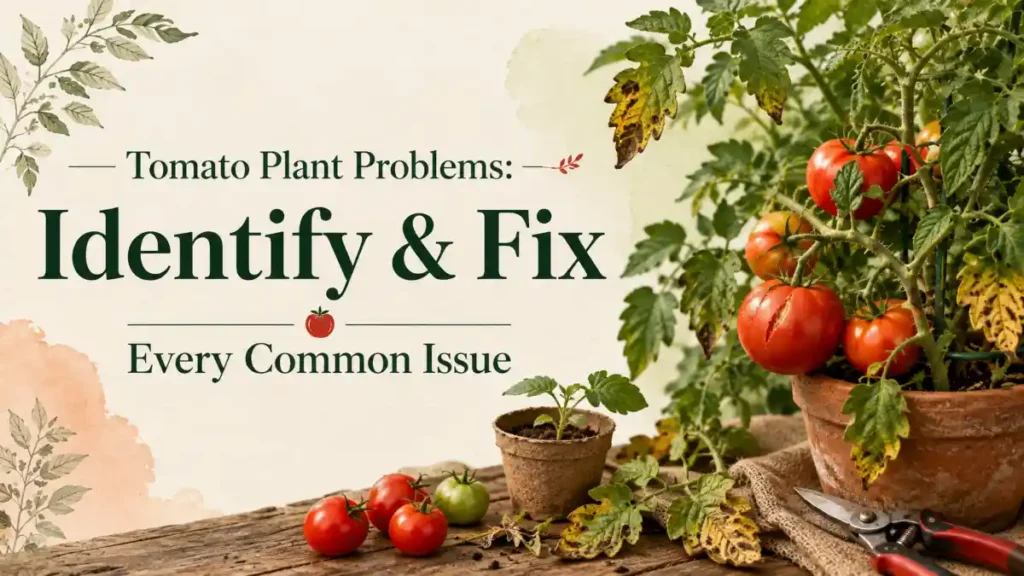
Something is wrong with your tomato plant. Maybe the leaves are turning yellow. Maybe the flowers keep dropping off. Or maybe you just picked your first ripe tomato, flipped it over, and found an ugly black patch on the bottom.
I have been there more times than I can count. So let me start with the good news I wish someone had told me years ago. Almost every tomato plant problem is fixable. And the few that are not fixable this season are preventable next season. You just need to know what you are looking at.
That is what this guide is for. Think of it as the diagnosis room. We will walk through every common tomato problem, what causes it, and exactly what to do about it. And if you want an answer in under a minute, try our free Tomato Problem Identifier. Answer a couple of quick questions and it points you straight to the likely culprit.
Start Here: Where the Problem Shows Up Tells You What It Is
Before we get into specific problems, here is the one trick that makes tomato diagnosis ten times easier. Look at where the trouble starts.
- Bottom leaves first. That points to a soil problem. Early blight, septoria leaf spot, and nitrogen shortage all start low and climb up the plant.
- Top leaves and new growth. Think pests, viruses, or weed killer drift. Soil diseases almost never start at the top.
- Fruit looks bad, plant looks fine. That is almost always watering or temperature. Usually not a disease at all.
- The whole plant is wilting. Either it is thirsty or it has a wilt disease. There is a simple test to tell them apart, and I will show you below.
Keep that little map in your head. It will save you from treating the wrong thing, which is the most common mistake I see growers make.
Why Are My Tomato Leaves Turning Yellow?
Yellow leaves are the number one tomato complaint in the world. The fix depends on the pattern, so find yours below.
A few yellow leaves at the bottom, plant looks happy
Relax. Tomato plants shed their oldest leaves as they grow. A few yellow leaves near the soil on a big healthy plant is just the plant cleaning house. Snip them off and move on with your day.
Lots of yellow lower leaves and a pale plant
This is usually a nitrogen shortage. When the plant runs low on nitrogen, it pulls it out of the old leaves to feed the new growth. So the bottom goes yellow first. Feed the plant with a balanced fertilizer and it should green up within a week or two.
Yellow leaves with brown or dark spots
Now we are talking disease. Skip down to the leaf spot section below because that is a different battle.
Yellowing on just one side of the plant
Yellowing that starts on one side of the plant, or even one half of a single leaf, is the classic calling card of fusarium wilt. That is a soil fungus and there is no cure. More on it in the wilting section.
Yellow all over plus soggy soil
You are loving your plant to death. Roots need air, and constantly wet soil drowns them. Let the top inch of soil dry out before you water again. The finger test never lies. Stick a finger in the soil, and if it comes out damp, wait.
Tomato Leaves Curling: Harmless or Trouble?
Here is a stat that should lower your blood pressure. Nine times out of ten, curling leaves are nothing.
Leaves rolling up in hot weather
When older leaves curl up along their length like little tacos, that is called physiological leaf roll. It is the plant protecting itself from heat and water stress. It looks alarming and hurts nothing. Keep the water steady and ignore it. Your harvest will not suffer.
Twisted, thin, deformed new growth
This one matters. If the new leaves come out twisted and strappy, like tiny gnarled fingers, the likely cause is weed killer drift. Lawn herbicides such as 2,4-D can travel on the breeze from surprisingly far away. Tomatoes are extremely sensitive to them. Also be careful with grass clippings as mulch if the lawn was treated. Mild cases grow out of it. Bad cases will not recover.
Curled leaves with sticky residue
Flip the leaf over. If you see clusters of tiny pear shaped insects, you have aphids. They suck sap and leave a sticky mess behind. A hard blast of water knocks most of them off, and ladybugs will happily eat the rest.
Small, curled, mottled leaves
Stunted new growth with a yellow and green mosaic pattern points to a virus. I hate delivering this news, but there is no treatment. Pull the plant so it does not spread, and wash your hands and tools before touching other plants.
Spots on Tomato Leaves: The Big Three Diseases
Leaf spot diseases cause more heartbreak than everything else combined. Here is how to tell the big three apart.
Early blight: dark spots with rings
Early blight shows up as brown spots with rings inside them, like a tiny bullseye, often with a yellow halo around each spot. It starts on the lower leaves and works its way up. It is a fungus that lives in the soil and splashes onto leaves when it rains.
The fix: snip off spotted leaves as soon as you see them. You can remove up to a third of the plant’s leaves without hurting it. Then mulch the soil to stop the splash, and water at the base instead of overhead.
Septoria leaf spot: lots of small spots
Septoria looks like someone flicked a paintbrush at your plant. You get dozens of small round spots with dark edges and gray or tan centers, again starting on the lower leaves. It spreads fast in wet weather. The treatment is exactly the same as early blight. Remove spotted leaves, mulch, water at the base.
Late blight: the emergency
Late blight is the one that should scare you. This is the same organism that caused the Irish potato famine, and it can take a healthy plant to dead in under a week.
Look for greasy looking dark blotches that do not form neat circles. They can start anywhere on the plant, including the top, and in damp mornings you may see white fuzzy mold on the underside of the leaves. Fruit gets big rough brown patches. It races through gardens in cool, wet weather.
If you get it, do not try to save the plant. Pull it, bag it, and put it in the trash. Never compost it. It feels brutal, but you are protecting every tomato and potato garden in your neighborhood.
Wilting Tomato Plant: The Overnight Test
A wilted plant with bone dry soil is just thirsty. Water it and it will bounce back within hours, looking slightly embarrassed about the drama.
A wilted plant with moist soil is a red flag. The usual suspects are fusarium and verticillium wilt, two soil fungi that clog the plant’s water pipes from the inside. Here is the tell: the plant wilts during the day, perks up overnight, and repeats that cycle for a while before it stops recovering at all.
To confirm it, cut a stem near the base and look at the inside. A brown ring in the stem means the pipes are stained, and the case is closed. There is no cure. Pull the plant, and do not plant tomatoes in that spot for a few years. The good news: many modern varieties resist both diseases. Look for the letters V and F on the label, and you can grow right past the problem next season.
Blossom End Rot and Other Tomato Fruit Problems
Blossom end rot: the black bottom
That dark, sunken, leathery patch on the bottom of your tomato is blossom end rot. It happens when the fruit does not get enough calcium while it is forming.
But here is the part almost everyone gets wrong. Your soil almost certainly has plenty of calcium. The real problem is delivery. Calcium travels in water, so when watering swings between drought and flood, the calcium never reaches the fruit. That is why eggshells, antacid tablets, and calcium sprays are mostly wasted effort. They treat a shortage that does not exist.
The actual fix is boring: water on a steady schedule and mulch to keep moisture even. That is it. The first fruits of the season often get it and later fruits come out clean once you steady the watering. And yes, an affected tomato is safe to eat. Cut off the ugly part and enjoy the rest.
Cracked tomatoes
Cracks in rings around the stem, or splits running down the fruit, happen when the plant drinks a lot of water fast. The inside grows quicker than the skin can stretch, usually after heavy rain follows a dry spell. Mulch and steady watering prevent most of it. And if a storm is coming, pick your nearly ripe tomatoes first. They will finish ripening on the counter. Our when to pick tomatoes guide shows exactly what stage is safe to pull.
Sunscald: pale blistered patches
A whitish, papery patch on the side of the fruit facing the sun is sunscald. Tomatoes actually need their leaves for shade. Sunscald usually happens when disease or heavy pruning strips too much leaf cover. So go easy on the pruning shears, and keep the foliage healthy.
Catfacing and zippering: the ugly ones
Deep scars, crevices, and puckered holes at the blossom end mean catfacing. It happens when flowers form during cold nights, and big beefsteak types get it most. A thin brown scar running down the fruit like a zipper is called exactly what you think: zippering. Both are purely cosmetic. The tomato tastes completely fine, and honestly, the ugly ones make the best sandwich stories.
Tomato Flowers Falling Off but No Fruit
Your plant is covered in yellow flowers, then they dry up and drop without a single tomato. This is called blossom drop, and the cause is almost always temperature.
Tomatoes set fruit best when nights stay between 55 and 75°F and days stay under about 90°F. Outside that range, the pollen gets sticky and pollination simply fails. The plant is fine. The weather is the problem.
What helps: be patient, because fruit set returns when the weather calms down. Give flower clusters a gentle shake around midday to help pollen move. And do not overdo nitrogen fertilizer, which pushes the plant to grow leaves instead of fruit. If heat waves ruin your fruit set every summer, timing is your best weapon. Our when to plant tomatoes calculator helps you schedule flowering before the worst heat arrives.
Common Tomato Pests and How to Beat Them
Hornworms: the invisible giants
If whole leaves and even small stems vanish overnight, you have hornworms. These fat green caterpillars grow as long as your finger, yet they match tomato leaves so perfectly that you can stare right at one and miss it.
Two tricks make the hunt easy. First, look for piles of black droppings on the leaves below, then search directly above them. Second, go out after dark with a UV flashlight. Hornworms glow under blacklight like tiny neon signs. Pick them off by hand and drop them in soapy water.
One exception: if you find a hornworm covered in little white capsules that look like grains of rice, leave it alone. Those are the cocoons of a tiny parasitic wasp. That hornworm is already finished eating, and the wasps that hatch will hunt every other hornworm in your garden. Nature is metal, and in this case it is on your side.
Aphids
Tiny soft insects clustered on new growth and flower stems. They cause curled leaves and sticky residue. Blast them off with water every few days and let ladybugs handle cleanup.
Flea beetles
Dozens of tiny round holes in the leaves, like someone fired a miniature shotgun, mean flea beetles. They mostly threaten young seedlings, so cover new transplants with row covers. Big established plants shrug the damage off.
Spider mites
In hot dry weather, look for leaves speckled with tiny yellow dots and fine webbing underneath. Those are spider mites. Spray the undersides of leaves with a strong jet of water every couple of days. They hate moisture.
Stink bugs
Cloudy white or yellow spots just under the skin of the fruit are stink bug feeding marks. The damage is shallow and the rest of the tomato is fine to eat. Hand pick the bugs in the morning when they are slow.
Cutworms
If a healthy seedling is lying on the ground one morning, cut clean at the base, blame cutworms. They strike overnight. Protect new transplants with a simple collar, like a toilet paper tube pushed an inch into the soil around the stem.
How to Prevent Tomato Plant Problems Next Season
Here is the secret that took me years to learn. Almost everything above traces back to three things: wet leaves, splashing soil, and stressed plants. Build these seven habits and most of this guide becomes something you never need again.
- Water at the base, on a steady schedule. Wet leaves invite disease, and uneven water causes rot and cracks.
- Mulch 2 to 3 inches deep. Mulch blocks the soil splash that carries blight spores onto your leaves. It is the cheapest disease control there is.
- Prune the bottom leaves. Once the plant is established, remove leaves touching or near the soil. That is the disease highway, so close it.
- Give plants room to breathe. Crowded plants stay wet longer and share diseases. Our tomato plant spacing calculator tells you exactly how far apart to plant.
- Rotate your crops. Do not plant tomatoes, peppers, or potatoes in the same spot two years running. Soil diseases wait for you there.
- Buy resistant varieties. Those letters on the seed label, like V, F, and N, mean the variety resists specific diseases. Check our tomato varieties guides to pick a tough one.
- Walk your garden daily. Take your coffee out there. Every problem in this guide is easy to beat at spot number one and hard to beat at leaf number fifty.
Tomato Problem FAQ: Quick Answers
Why are my tomato leaves turning yellow at the bottom?
A few yellow leaves are normal aging. Many yellow lower leaves usually mean a nitrogen shortage, and yellow leaves with dark spots mean early blight or septoria. Check the pattern first, then treat.
Can I eat tomatoes with blossom end rot?
Yes. Blossom end rot is a growth defect, not a disease. Cut away the dark patch and the rest of the fruit is perfectly safe and tasty.
Should I remove leaves with brown spots?
Yes, and quickly. Removing spotted leaves slows the disease down a lot. You can safely take up to a third of the plant’s leaves. Throw them in the trash, not the compost.
Why are my tomato flowers falling off without making fruit?
Temperature, almost every time. Nights below 55°F, nights above 75°F, or days above 90°F all break pollination. Fruit set comes back when the weather does.
What is eating my tomato leaves overnight?
Big missing chunks overnight almost always mean hornworms. Look for black droppings on the leaves and hunt directly above them, or use a UV flashlight after dark. They glow.
Can a wilted tomato plant recover?
If the soil is dry, yes. Water it and it recovers within hours. If the soil is moist and the plant keeps wilting day after day, it likely has a wilt disease, and it will not recover. Pull it and plant a resistant variety next time.
The Diagnosis Library
When you need the deep dive, go straight to the guide that matches your symptom: disease identification, pest damage detective work, leaf trouble decoded, ugly or damaged fruit, flowers that won’t set fruit, and hunger signs and nutrient issues.
You Can Fix This
Every tomato grower on earth deals with these problems. The people who harvest baskets of tomatoes anyway are not lucky. They just catch things early and know what they are looking at. Now you do too.
If you are still not sure what is wrong with your plant, run it through our problem identifier tool. And once your plant is back on its feet, our growing tomatoes guides will help you keep it that way from seed to harvest.