
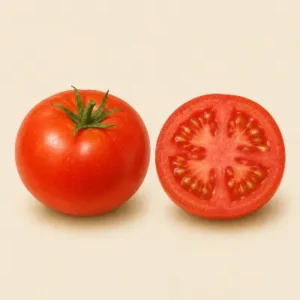
Defiant Tomato
Johnny's Selected Seeds' own answer to the 2009 blight epidemic: a compact dual gene workhorse that quietly out yields its famous cousins in trials.
Flavor & performance
The honest verdict
What's great
- Highest red slicer fruit count in Cornell's trial
- Dual gene late blight plus early blight resistance
- Compact habit thrives in 5 gallon buckets
- Out yielded Mountain Merit in two university trials
- Early at ~70 days, allows fall second crop
Watch out for
- Yellow shoulder on many fruit, both trials flagged it
- Fruit often smaller than the catalog claim
- Mid pack flavor, wins no taste panels
- Concentrated determinate harvest window
- F1 hybrid, saved seed will not come true
Grow it in your zone
| Trait | Defiant Tomato | Mountain Merit | Damsel |
|---|---|---|---|
| Type | Hybrid, determinate | Hybrid, determinate | Hybrid, indeterminate |
| Days | ~70 | ~75 | 73–75 |
| Fruit | 6–8 oz red | 8–12 oz red | 8–12 oz pink |
| Late blight | Ph2+Ph3 | Ph2+Ph3 | Resistant |
| Extra resistance | Early blight | Nematodes, TSWV | Nematodes |
| Flavor rank | Mid pack | Mid pack | Panel favorite |
| Cornell fruit count | 56.5/plant, highest | Lower | Not tested |
The seed catalog that got tired of waiting
In 2009, late blight burned through the Northeast and took most of New England’s tomatoes with it. One garden columnist summed up the year simply: his tomatoes, along with most gardeners’ tomatoes throughout the region, were devastated.
Johnny’s Selected Seeds, the employee owned Maine catalog, decided not to wait for someone else’s fix. Working with parent material from North Carolina State’s breeding program, it produced its own answer and released it in 2011.
The name told you the mission, and the suffix told you the science. The Defiant tomato ships as Defiant PhR, short for Phytophthora resistance, the genus name of the late blight organism itself.
Fifteen years on, it has become the quiet workhorse of the blight resistant class, winning trial categories while flashier names get the headlines. This guide covers the record, the one cosmetic flaw both universities flagged, and how to grow it well.
What the Defiant tomato actually is
This is a compact determinate hybrid, ripening around 70 days from transplant. Cornell’s garden fact sheet lists round red fruit of 6 to 8 ounces, though real world sizes scatter, and more on that later.
The resistance package is broader than the headline. Cornell’s tables credit it with late blight resistance from the stacked Ph 2 and Ph 3 genes, plus early blight, verticillium, and both common fusarium races.
That early blight entry deserves a highlight. Most late blight varieties leave the door open to its slower, uglier cousin, and this one at least partially closes it.
The Mountain Merit cousin connection
Here is a family detail that explains years of trial results. The parent line Johnny’s used came from North Carolina State, the same program that bred Mountain Merit.
That makes the two varieties something like cousins, and they behave like it. Trial after trial finds them within a step of each other on disease control, flavor scores, and general conduct.
The practical meaning for a gardener choosing between them: you are choosing between two branches of the same breeding heritage. The differences are real but small, and the rest of this guide names them.
The trial numbers nobody brags about
For a variety with a modest reputation, the Defiant tomato keeps topping charts. In Cornell’s 2013 evaluation, it produced 56.5 fruit per plant, the highest count of any red slicer in the trial, out yielding both Mountain Merit and Mountain Magic.
Penn State’s organic trial repeated the pattern. Defiant beat Mountain Merit on marketable yield by weight, with more usable medium sized fruit.
The disease numbers matched. Cornell recorded its late blight severity among the lowest in the field, with suppression statistically comparable to its more famous rivals, even though its two resistance genes are carried in single copies.
Growers in blight country report the same in plain language: plants that keep producing after disease arrives in the neighborhood. As the columnist who introduced it warned, this is resistance, not immunity, but it is resistance that shows up.
What it actually tastes like
The panels put it mid pack, and the numbers are consistent. Cornell scored its taste 3.5 out of 5 in 2012 and about 3.67 in 2013, roughly tied with Mountain Merit and comfortably ahead of Iron Lady.
Everyday growers grade it a notch higher than the panels. The New Hampshire columnist compared its taste to Celebrity, a Nova Scotia garden author calls it one of her go to varieties with juicy, flavorful fruit, and a Wisconsin participatory trial rated it among the best flavored at one of its sites.
The fair reading: dependable, balanced, classic hybrid slicer flavor. Nobody plants it for transcendence, and nobody pulls it out over taste either.
If flavor tops your list among blight resistant options, the panels point elsewhere, and this site’s Damsel guide covers that trade. If total harvest tops your list, stay right here.
The yellow shoulder problem
Both universities flagged the same cosmetic flaw, which earns it a section. Cornell’s notes record yellow shoulder on most fruit, and Penn State found yellow shoulder a common reason Defiant fruit got culled.
Yellow shoulder leaves a hard, pale patch at the stem end that never ripens red. It is a physiological quirk, not a disease, and Penn State’s note points at a suspected driver: potassium supply.
The management list is short. Keep potassium adequate, skip aggressive pruning so foliage shades the shoulders, and avoid the hottest, most exposed planting spots.
When it shows up anyway, the fix is a knife. The patch cuts away cleanly, and the fruit underneath is fine.
The size question, answered honestly
Size claims for this variety scatter more than most. The catalog says 6 to 8 ounces, Penn State recorded 8 to 12, and Cornell’s 2013 trial fruit averaged closer to 3.
The spread is real information. This variety sizes up or down with growing conditions, season length, and fruit load more than a steady commercial type would.
Plan for a tennis ball on a good day and a golf ball in a tough season. The count per plant, not the size per fruit, is where this tomato earns its keep.
Who actually grows it
The map of its fans tells the story. New England gardeners who lived through 2009 adopted it first, and it spread through Atlantic Canada, the upper Midwest, and every region where wet summers make blight a recurring character.
Organic growers took to it because certified organic seed is available and the resistance does the work sprays otherwise would. Container gardeners found the compact determinate habit suits buckets, with one North Carolina grower reporting 25 to 38 fruit per plant in 5 gallon containers.
It is, in short, the sensible pick of the blight class. That is exactly why it gets less press than its flashier relatives, and why it keeps selling anyway.
The best ways to use it
The mid size fruit is built for the everyday kitchen. Halved for salads, sliced for burgers, and diced for salsa, it does the weekday work without ceremony.
The heavy count per plant makes it a legitimate small batch canner despite the slicer label. A few plants deliver sauce quantities in the concentrated determinate window.
Its firm, tidy fruit also packs and travels well. If your tomatoes commute, to work, to neighbors, to a market table, this one arrives intact.
Roasting deserves a mention too. Halved fruit on a sheet pan concentrates the mild flavor into something noticeably richer, which is the easiest upgrade this variety has, and the batches freeze flat in bags for winter.
How to grow the Defiant tomato, start to finish
Starting seeds
Start seeds indoors 6 to 8 weeks before your last frost. Sow a quarter inch deep in fresh seed starting mix, kept warm around 70 to 80°F.
Give strong light the moment they sprout so they stay stocky. Pot up at the first true leaves and feed at half strength.
Transplanting and spacing
Plant out after frost, once nights hold above 50°F. Harden the seedlings off over a week first, then bury two thirds of the stem for strong roots.
Space plants about 2 feet apart. The compact determinate habit keeps rows tidy.
One scheduling trick suits this variety especially well. Because it finishes fast and blight usually arrives late, a second planting set out in early summer ripens a fresh crop in early fall, still under the protection of its resistance genes.
Long season gardeners get two full determinate cycles that way. Short season gardeners simply plant once, on time, and let the 70 day clock do the work.
Soil and feeding
Grow it in rich, well drained soil at a pH near 6.2 to 6.8. Work compost and a balanced fertilizer into the planting hole, then feed lightly once fruit sets. Our guide to feeding tomatoes covers the timing.
Given the yellow shoulder pattern, make sure potassium is not the weak link. A soil test beats guessing, and a tomato formula feed leans the right direction.
Light and water
Give it full sun, at least 6 to 8 hours a day. Water deeply and evenly, aiming for 1 to 2 inches a week at the base.
Steady moisture supports the heavy fruit count and keeps the skins whole. Our guide to watering tomatoes covers the rhythm.
Support
A standard cage set at planting handles this plant easily. Support matters most when 50 plus fruit load onto a compact frame at once. Our guide to supporting tomato plants lays out the options.
Skip heavy pruning entirely. The foliage is shading fruit shoulders that badly want the shade.
Growing in containers
This is one of the strongest container candidates in the blight resistant class. Real growers report full harvests from 5 gallon buckets, though 10 gallons buys steadier moisture.
Check pots daily in heat. Our guide to growing tomatoes in pots covers the basics.
Grower's Picks for Defiant
Start with the equipment you already have. These options match the plant size and uses described above; choose what fits your growing setup.
As an Amazon Associate I earn from qualifying purchases. Affiliate disclosure. Check the selected size, contents and current availability before ordering.
Garden support stakes
For training and tying upright stems. Install early and use soft ties with room for growth.
Check usable height after insertion. Larger vines may need a taller or reinforced framework.
Check options on AmazonRain Bird garden drip kit
Useful for a bed or several plants where you want watering directed to the root zone.
Check faucet, pressure and fitting requirements. Adjust watering to the soil; one pot may be easier to water by hand.
Check options on AmazonEspoma Tomato-tone
A granular feeding option when your soil or potting mix needs nutrients. Follow the label and account for existing fertilizer.
Extra fertilizer is not a cure for blossom end rot. Check moisture and soil conditions first.
Check options on AmazonEZ-Straw seeding mulch
An optional bed mulch to reduce evaporation and soil splash. Keep it away from direct contact with stems.
Check the selected product and additives. Use suitable mulch you already have instead of buying a bale for one pot.
Check options on AmazonProblems to watch
Yellow shoulder. The signature cosmetic flaw, flagged by both Cornell and Penn State. Adequate potassium, unpruned foliage, and a paring knife manage it.
Fruit running small. Under stress or heavy load, expect golf balls rather than tennis balls. Thin the load early if size matters to you.
Expecting immunity. Resistance held up in every trial, but it is a shield, not a wall. Airflow and clean watering still count, and our tomato disease guide covers the signs.
The determinate clock. The crop arrives in a concentrated window of several weeks, then winds down. Plant a second round in long season areas, and see our tomato problem guide for fruit issues along the way.
Harvest and storage
Pick each fruit at full red with a slight give, cutting rather than pulling when clusters hang heavy. A plant carrying 50 fruit appreciates gentle bookkeeping.
Store ripe fruit at room temperature and use within several days. The firm flesh holds better on the counter than most in its class.
When frost threatens the tail of the crop, fruit showing any blush finishes indoors reliably. The concentrated set means less hanging green at the end than an indeterminate would leave.
Saving seeds
This is not a variety to save seed from. Defiant is an F1 hybrid, and saved seed scatters back toward its parent lines, taking the stacked resistance with it.
Buy fresh seed and store the packet cool and dry, where it stays viable for years. Organic seed is available for certified growers and those who prefer it.
If seed saving is part of your gardening, run an open pollinated variety alongside it and save from that plant instead.
Defiant vs Mountain Merit vs Damsel
Against Mountain Merit, its breeding cousin, the differences are honest but narrow. Defiant counts more fruit per plant and adds early blight resistance, while Mountain Merit brings bigger fruit and the broader nematode and spotted wilt package.
Against Damsel, the flavor first member of the blight class, the trade is clear. Damsel wins every taste panel between them, while the Defiant tomato wins on yield, earliness, compactness, and a skin that does not crack at the first storm.
My honest take is simple. Pick Damsel for the sandwich, Mountain Merit for the broadest shield, and Defiant for the most tomatoes per square foot of blight country. There is no wrong answer in this family, which is the point of the family.
The verdict
The Defiant tomato is what dependability looks like in the blight resistant era. It out counts its famous cousins in the trials, holds its disease numbers with the best of them, and asks for nothing but a cage and steady water.
Its flaws are a pale shoulder you can cut off and a flavor that wins no medals. For a tomato bred so New England gardeners would never repeat 2009, those are cheap prices.
Grow it if your summers are wet, your space is tight, or your patience for drama is gone. The name promised defiance, and fifteen years of trial tables say it delivered.
Cornell University: Disease Resistant Tomato Varieties. https://www.vegetables.cornell.edu/pest-management/disease-factsheets/disease-resistant-vegetable-varieties/disease-resistant-tomato-varieties/
Penn State Extension: Organic Late Blight Tomato Cultivar Evaluation. https://extension.psu.edu/organic-late-blight-tomato-cultivar-evaluation