
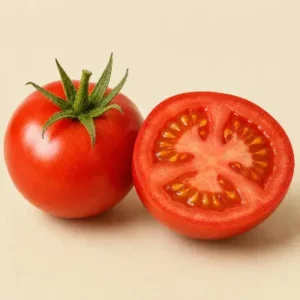
Damsel Tomato
An independent breeder's truce in the heirloom versus hybrid war: pink heirloom flavor that survives taste panels, wrapped in late blight resistance.
Flavor & performance
The honest verdict
What's great
- Best rated flavor among blight resistant tomatoes
- Cornell listed late blight and nematode resistance
- Growers report clean plants bearing to frost
- Pink heirloom looks that sell at market
- Holds ripe on the vine unusually well
Watch out for
- Cracks badly under rain and water swings
- Green shoulders in hot, exposed conditions
- F1 hybrid, saved seed will not come true
- Organic seed from a small breeder runs pricey
- Specific resistance genes not publicly documented
Grow it in your zone
| Trait | Damsel Tomato | Brandywine | Mountain Merit |
|---|---|---|---|
| Type | Hybrid, indeterminate | Heirloom, indeterminate | Hybrid, determinate |
| Days | 73–75 | 80–100 | ~75 |
| Fruit | 8–12 oz pink | 1 lb+ pink | 8–12 oz red |
| Flavor | Near heirloom, panel favorite | The benchmark | Mild, commercial |
| Late blight | Resistant | None | Ph2+Ph3 resistant |
| Weakness | Cracking in rain | Disease, low yield | Flavor ceiling |
| Save seeds | No | Yes | No |
The oldest argument in tomato gardening, and a truce
Every gardener eventually picks a side. Heirloom people accept disease and dead vines as the price of real flavor. Hybrid people accept polite, forgettable tomatoes as the price of a harvest that survives.
The Damsel tomato was bred to end that argument. It is a modern hybrid carrying late blight resistance, wrapped around a pink, 8 to 12 ounce fruit. The whole point is tasting like the heirlooms on the other side of the fence.
Plenty of varieties have made that promise. What makes this one worth a full guide is that the taste panels, trial records, and grower reports mostly agree it delivers. One honest weakness gets skipped by the marketing, though.
This guide covers the one man breeding operation behind it, the evidence on both the flavor and the resistance, the cracking problem nobody advertises, and how to grow it well.
What the Damsel tomato actually is
This is an indeterminate F1 hybrid producing pink, slightly flattened globes of 8 to 12 ounces, ripening around 73 to 75 days from transplant. The color and shape deliberately imitate classic pink heirlooms.
The resistance package is the modern half of the bargain. Cornell’s disease resistant variety tables list it for late blight, root knot nematodes, and verticillium wilt.
Its seed sells mostly through organic catalogs, often under the tongue in cheek label of a Hyloom, a hybrid pretending to be an heirloom. The plant grows with moderate, manageable vigor and holds ripe fruit on the vine well.
The one man band behind it
Damsel did not come from a university program or a seed conglomerate. It was bred by Dr. Jason Cavatorta, a Cornell trained plant breeder who left a corporate career breeding onions.
He now runs his own tiny operation, EarthWork Seeds. One breeder, one small company, one very good idea.
That distinction is worth a correction, because this variety often gets credited to Cornell itself. Cornell’s tomato breeding program produced Iron Lady, Stellar, and BrandyWise, and Damsel is not on that list. The Cornell connection is the breeder’s training, not the tomato’s address.
The variety surfaced in organic trial networks around 2017 and reached catalogs shortly after. For one independent breeder, landing a variety in the major organic catalogs within a few years is its own endorsement.
Does the heirloom flavor claim actually hold?
Flavor claims on hybrid tomatoes deserve suspicion, so here is the actual record. It is unusually strong.
The University of Wisconsin’s Seed to Kitchen Collaborative, which runs variety trials with chefs and farmers scoring flavor, rated it among the best flavored tomatoes in its trials. An organic trial at Evergreen State College measured sugar levels at a Brix of nearly 7, high for a full sized slicer. Its write up called the variety the Holy Grail of tomatoes, hybrid vigor with heirloom taste.
Independent gardeners add the everyday version. One long time garden blogger runs side by side taste offs every season. He reported it beating its competition handily, year after year, as the best tasting blight resistant variety he had grown.
The honest ceiling: nobody credible claims it beats a perfect Brandywine in a perfect year. The consistent claim is different and more useful, that it tastes closer to a pink heirloom than anything else wearing a resistance package.
The resistance record, with its fine print
The field reports on disease are the kind growers dream about. One 30 year gardener reported never having seen a tomato keep producing until a freeze with absolutely no blight. Others describe their other varieties dying around a clean, loaded Damsel.
Cornell’s research explains what likely powers that. Their trials showed varieties stacking both the Ph 2 and Ph 3 late blight genes controlled the modern US 23 strain at 93 to 98 percent, where either gene alone failed.
Here is the fine print, stated honestly. Catalogs describe Damsel as carrying that dual gene stack, but no public university document confirms its specific genes.
The field performance is well attested either way. The genetic paperwork, though, remains a catalog claim until someone publishes it.
The nematode resistance deserves its own mention. For gardeners in sandy Southern soils where root knot nematodes quietly halve harvests, that trait may matter more than the headline blight resistance.
The gap in the armor is the skin
Every variety pays for its virtues somewhere, and this one pays at the surface. The most documented weakness of the Damsel tomato is cracking.
Penn State’s organic trial put numbers on it. In a wet fall, the variety’s unmarketable fruit exceeded its marketable fruit, driven by cracking and rain checked skin. Its marketable yield still matched the trial’s standard variety.
The trial record adds green shoulders in some conditions, and even its main seed seller warns the skin may crack under stress. Field resistance means nothing to a thunderstorm.
So the honest picture is a tomato armored against disease and vulnerable to water swings. That weakness is manageable, and the next section is the manual.
Keeping the skin whole
Cracking in tomatoes follows water, not luck. A dry stretch followed by heavy rain swells the fruit faster than the skin can stretch, and the skin loses.
Mulch and steady deep watering flatten those swings, and they are the single biggest fix. A soaker hose under mulch does for a backyard what drip tape does for the trial farms.
The second fix is timing. Once fruit shows first blush, it can finish on the counter with no flavor penalty, so pick ahead of any forecast downpour.
Growers under high tunnels or any rain cover report the cleanest fruit of all. This variety’s trial pedigree is organic field production, but its skin would thank you for a roof.
Who actually grows it
The customer base tells you what the variety is. Organic market growers and CSA farms adopted it fast, because a pink heirloom look with real disease insurance is a business plan, not just a preference.
One seed company tells of a Massachusetts farmer who could not keep up with chef orders for it. Restaurant demand for a hybrid is rare, and it tracks the taste panel results.
For home gardeners, the same logic scales down. If late blight has ever taken your August crop, this is the flavor first version of insurance.
It also makes a smart anchor plant in a mixed heirloom bed. Whatever the season does to the divas around it, one Damsel quietly guarantees the sandwich supply.
The best ways to use it
Treat it like the pink heirloom it imitates. Thick slices on bread with salt and mayonnaise are the highest use, and the balanced, sweet acid flavor needs no help.
It holds together well enough for burgers and panzanella, softer than a commercial slicer but firmer than a dead ripe Brandywine. Salads take its slices without the plate flooding.
Cooked, it makes a sweet, mild, rosy sauce, though that feels like hiring a portrait painter to whitewash a fence. Cook the cracked ones, slice the perfect ones.
How to grow the Damsel tomato, start to finish
Starting seeds
Start seeds indoors 6 to 8 weeks before your last frost. Sow a quarter inch deep in fresh seed starting mix, kept warm around 70 to 80°F.
Give strong light the moment they sprout so they stay stocky. Pot up at the first true leaves and feed at half strength.
Transplanting and spacing
Plant out after frost, once nights hold above 50°F. Harden the seedlings off over a week first, then bury two thirds of the stem for strong roots.
Space plants 2 to 3 feet apart. Moderate vigor for an indeterminate still means a real vine by August.
Soil and feeding
Grow it in rich, well drained soil at a pH near 6.2 to 6.8. Work compost and a balanced fertilizer into the planting hole, then feed lightly once fruit sets. Our guide to feeding tomatoes covers the timing.
Steady nutrition beats surges here, since growth spurts stress the skin the same way water spikes do.
Light and water
Give it full sun, at least 6 to 8 hours a day. Water deeply and evenly, aiming for 1 to 2 inches a week at the base, and never let it swing between drought and flood.
Watering discipline is the entire anti cracking program. Our guide to watering tomatoes covers the rhythm.
Support
An indeterminate vine bearing to frost needs a tall stake or heavy duty cage set at planting. Keeping fruit off the ground also protects the one thing its resistance genes cannot, the skin. Our guide to supporting tomato plants lays out the options.
Growing in containers
Workable with volume and vigilance. Use a 15 to 20 gallon pot with a tall support, and check moisture daily, since container watering swings are cracking invitations.
Our guide to growing tomatoes in pots covers the basics.
Grower's Picks for Damsel
Start with the equipment you already have. These options match the plant size and uses described above; choose what fits your growing setup.
As an Amazon Associate I earn from qualifying purchases. Affiliate disclosure. Check the selected size, contents and current availability before ordering.
Garden support stakes
For training and tying upright stems. Install early and use soft ties with room for growth.
Check usable height after insertion. Larger vines may need a taller or reinforced framework.
Check options on AmazonRain Bird garden drip kit
Useful for a bed or several plants where you want watering directed to the root zone.
Check faucet, pressure and fitting requirements. Adjust watering to the soil; one pot may be easier to water by hand.
Check options on AmazonEspoma Tomato-tone
A granular feeding option when your soil or potting mix needs nutrients. Follow the label and account for existing fertilizer.
Extra fertilizer is not a cure for blossom end rot. Check moisture and soil conditions first.
Check options on AmazonEZ-Straw seeding mulch
An optional bed mulch to reduce evaporation and soil splash. Keep it away from direct contact with stems.
Check the selected product and additives. Use suitable mulch you already have instead of buying a bale for one pot.
Check options on AmazonProblems to watch
Cracking after rain. The documented weakness. Mulch, steady water, and picking at blush before storms prevent most of it, and our tomato problem guide covers the rest.
Green shoulders in hot sun. Noted in trial records. Leave the foliage unpruned above fruit clusters for shade, and cut shoulders away at the board.
Expecting immunity. Resistance is a strong shield, not a force field. Airflow and clean watering still matter, and our tomato disease guide covers what to watch.
Seed price sticker shock. Organic F1 seed from a small breeder costs real money per packet. One packet lasts years if stored cool and dry.
Harvest and storage
Pick at full pink with a slight give, or at first blush when rain threatens. Trial notes praise how well ripe fruit holds on the vine, a quiet virtue when vacation and harvest collide.
Store ripe fruit at room temperature and eat within several days. The flavor that justifies this variety does not survive refrigeration.
Late fruit keeps coming until frost, per the field reports. Fruit showing any blush at frost finishes indoors reliably.
Saving seeds
This is not a variety to save seed from. Damsel is an F1 hybrid, and saved seed splits back toward its parent lines, scattering both the flavor and the resistance.
The breeding that stacked those traits lives in the cross itself, which is why fresh seed each year is the arrangement. Buy from the organic catalogs that carry it, and store the packet cool and dry.
If seed independence matters to you, grow an open pollinated pink like Brandywine alongside it, and let each do its job.
Damsel vs Brandywine vs Mountain Merit
Against Brandywine, the flavor benchmark it chases, the honest verdict is close but not crowned. A perfect Brandywine still wins the taste test, while Damsel wins the season, ripening earlier, yielding steadier, and standing through blight that ends Brandywine’s year.
Against Mountain Merit, the dual gene resistance standard, the contest flips. Mountain Merit brings the broader documented package and a firmer commercial fruit, while the Damsel tomato brings clearly better flavor by every panel that has scored them.
My honest take is simple. If blight is your enemy and flavor is your religion, Damsel is the best truce currently for sale. Keep the water steady, and it keeps both promises.
The verdict
The Damsel tomato is the rare marketing claim that survives an audit. The flavor scores, the Brix numbers, and the blight year testimonies all point the same direction: this is the best tasting insurance policy in the seed rack.
Its weakness is real but narrow. The skin cracks under water stress, and the fix is discipline, not luck.
Grow it if you are tired of choosing between an August funeral for your heirlooms and a polite hybrid you never loved. One vine of this, watered like you mean it, ends the argument in your own backyard.
Penn State Extension: Organic Late Blight Tomato Cultivar Evaluation. https://extension.psu.edu/organic-late-blight-tomato-cultivar-evaluation
Cornell University: Evaluation of Late Blight Resistant Tomato Varieties. https://www.vegetables.cornell.edu/pest-management/disease-factsheets/disease-resistant-vegetable-varieties/evaluation-of-late-blight-resistant-tomato-varieties/