
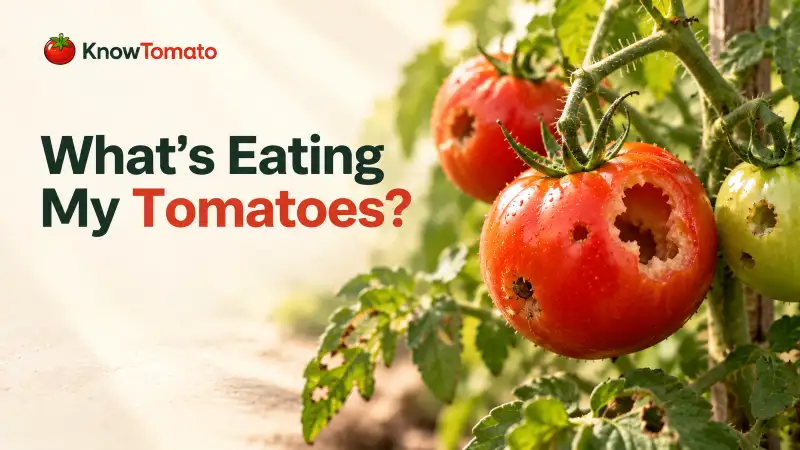
What’s eating my tomatoes is easier to answer once the damage itself becomes the clue. Take a classic case: tiny holes appearing in tomato leaves over the course of a week, small flying insects hovering nearby, and nothing visible on close inspection.
A closer look eventually turned up tiny black bugs that jumped when disturbed. That single detail, jumping on contact, pointed straight to the culprit before any product got involved.
This guide sorts common tomato pests by what their damage actually looks like. Match the pattern below to what is happening on your plants. Then follow the link to the specific culprit for real treatment options.
The short version
Small round holes that look shot through call for a look at flea beetles. Seedlings that vanish or get cut off right at the soil line point to cutworms instead.
Sticky, wilting leaves with clusters of tiny insects mean aphids. Ragged holes paired with silvery slime trails mean slugs or snails instead.
Dusty, stippled leaves during hot, dry weather suggest spider mites. Large sections of leaf stripped down to bare stems point toward tomato hornworms.
Cloudy spots on the fruit itself, rather than the leaves, point toward stink bugs. Identifying the pattern first keeps a gardener from reaching for the wrong product.
Small, round holes: flea beetles
That Garden.org forum thread was started by a gardener known as hstrent51. It ended with a confirmed flea beetle diagnosis once the jumping black bugs turned up. South Dakota State University Extension describes the classic damage these insects leave behind.
Adult flea beetles chew numerous small holes across infested leaves. The look is often compared to a shotgun blast.
The insects themselves measure less than an eighth of an inch, dark and shiny. Enlarged hind legs let them jump away instantly.
Young seedlings take the worst of it. Severe feeding can cause serious stunting or even kill small plants outright. Established plants usually tolerate the damage better.
Floating row covers keep adults off vulnerable seedlings before damage starts. South Dakota State University Extension also lists radish or alyssum as trap crops. Both can pull beetles away from tomatoes.
Neem oil and diatomaceous earth are options applied directly on and around plants.
Any insecticide used for a heavier infestation should be checked against its label first. Not every product is approved for flea beetles specifically.
Seedlings that vanish overnight: cutworms
A tomato seedling that simply disappears was probably not eaten by anything still on the plant. The same goes for one cut off right at the soil line.
University of Maryland Extension describes cutworm larvae dragging cut seedlings underground at night. That is why no pest is visible during the day.
In Maryland, University of Maryland Extension notes young larvae start feeding on foliage in early May, though timing shifts with local climate. Older larvae move down to the soil surface and cut plants off at or just below ground level. Tomatoes rank high among a very wide host range of garden vegetables.
A simple barrier stops most of the damage before it starts. University of Maryland Extension recommends a three inch cardboard, foil, or plastic collar. Push it into the soil around each stem.
Coarse materials like crushed oyster shell, sand, or diatomaceous earth placed around stems add another layer of deterrence. Bacillus thuringiensis, known as Bt, is an organic option that kills young larvae before they reach the cutting stage.
Sticky, wilting leaves with tiny clustered insects: aphids
Aphids give themselves away by where they cluster and what they leave behind. Washington State University’s Hortsense program describes soft bodied, pear shaped insects in shades of yellow, pink, green, or black. They gather on new growth and the undersides of leaves.
Feeding causes leaves to yellow and wilt. A sticky residue called honeydew follows, often attracting ants or developing a coating of sooty mold on nearby foliage.
Natural predators do a lot of the work already. Ladybird beetles, lacewings, hover fly larvae, and parasitic wasps all feed on aphids. A strong stream of water from a hose can physically knock a light infestation off a plant too.
Cutting back on nitrogen fertilizer matters more than most gardeners expect. High nitrogen levels actually encourage aphids to reproduce faster.
When a spray becomes necessary, Washington State University’s program recommends two organic options. An azadirachtin based neem product is one, and an insecticidal soap made from potassium salts of fatty acids is the other.
Apply either one with thorough coverage on both sides of the leaves.
Ragged holes and slime trails: slugs and snails
Ragged holes chewed into the interior of a leaf, rather than starting at the edge, point away from insects entirely. University of Maryland Extension describes slugs and snails feeding on every part of a tomato plant. That includes rasped patches directly on the fruit.
The real giveaway is the residue left behind. Slugs typically leave a silvery slime trail wherever they travel, visible on leaves, stems, soil, or any nearby surface.
Slug baits built around iron phosphate or ferric sodium EDTA are considered less toxic to pets. Both are safe for home food gardens. Removing debris, rocks, and other hiding spots helps too, and handpicking at night cuts down the population without any bait at all.
Dusty, stippled leaves in hot weather: spider mites
Hot, dry stretches are when spider mite damage shows up fastest. Utah State University Extension describes small yellow stippling on leaves that progresses to a bronzed or reddish discoloration. Fine webbing can make a plant look dusty or dirty too.
Reproduction moves fast in summer heat. A full generation can complete in as few as ten to fourteen days. That pace allows eight or more generations across a single season.
One warning matters more here than for most pests. Utah State University Extension cautions against using malathion or pyrethroid insecticides against other pests nearby. Both classes of chemical actually stimulate spider mite reproduction rather than controlling it.
A strong stream of water washes many mites off a plant directly. Insecticidal soap is the organic option that source recommends.
Spray it at night to reduce the risk of leaf damage in hot weather. Thorough coverage on the undersides of leaves matters most, since that is where mites concentrate.
Leaves stripped to bare stems: tomato hornworms
Large sections of foliage disappearing almost overnight point to tomato hornworms rather than any of the smaller pests above. Dark green or black droppings on nearby leaves are another clue. These caterpillars can strip a plant fast enough to notice within a single day.
This guide’s dedicated hornworm article covers identification, handpicking, and Bt treatment. It also covers when a hornworm carrying parasitic wasp cocoons should be left alone rather than removed.
Cloudy spots on the fruit, not the leaves: stink bugs
When the damage shows up on tomatoes themselves rather than the leaves, the culprit is usually feeding on fruit directly. A cloudy, discolored spot with white spongy tissue underneath the skin is the signature stink bugs leave behind.
This guide’s dedicated stink bug article covers the full identification process and scouting with a simple shake test. It also covers which treatments genuinely help.
Frequently asked questions
How do I know what’s eating my tomato leaves?
Match the damage pattern to the culprit. Small round holes suggest flea beetles, and ragged interior holes with slime trails suggest slugs. Large stripped sections point to hornworms instead.
What is leaving tiny holes in my tomato leaves?
Flea beetles are the most common cause of small, shotgun style holes. Look for tiny, dark, shiny beetles that jump away the moment a leaf is disturbed.
Why did my tomato seedling disappear overnight?
Cutworms are the likely cause. They cut young plants off at the soil line at night and can drag small seedlings underground. No visible pest is left behind during the day.
Are ants on my tomato plant a sign of a pest problem?
Often, yes. Ants are frequently drawn to the sticky honeydew aphids leave behind. Ant activity on a tomato plant is worth checking as a possible sign of aphids.
Can hot weather make a tomato pest problem worse?
Yes, especially with spider mites. Hot, dry conditions let them complete a generation in as little as ten to fourteen days. Using the wrong insecticide against other pests nearby can make an existing mite problem worse instead of better.
The bottom line: what’s eating my tomatoes usually reveals itself through the damage pattern before a single bug ever gets identified by sight. Small holes, vanished seedlings, sticky wilting leaves, slime trails, and stippled dusty foliage each point toward a different, specific culprit. For the full pest lineup this guide summarizes, see our tomato pests guide. For the two pests covered in depth elsewhere on this site, see our tomato hornworms guide and our stink bugs on tomatoes guide.
SOURCES
South Dakota State University Extension: What’s Causing the Tiny Holes on My Tomato Leaves? https://extension.sdstate.edu/whats-causing-tiny-holes-my-tomato-leaves
University of Maryland Extension: Cutworm, Vegetables. https://extension.umd.edu/resource/cutworm-vegetables
Washington State University, Hortsense: Tomato, Aphids. https://hortsense.cahnrs.wsu.edu/fact-sheet/tomato-aphids/
University of Maryland Extension: Slugs and Snails, Vegetables. https://extension.umd.edu/resource/slugs-and-snails-vegetables
Utah State University Extension: Spider Mites. https://extension.usu.edu/planthealth/ipm/notes_ag/veg-spider-mites