
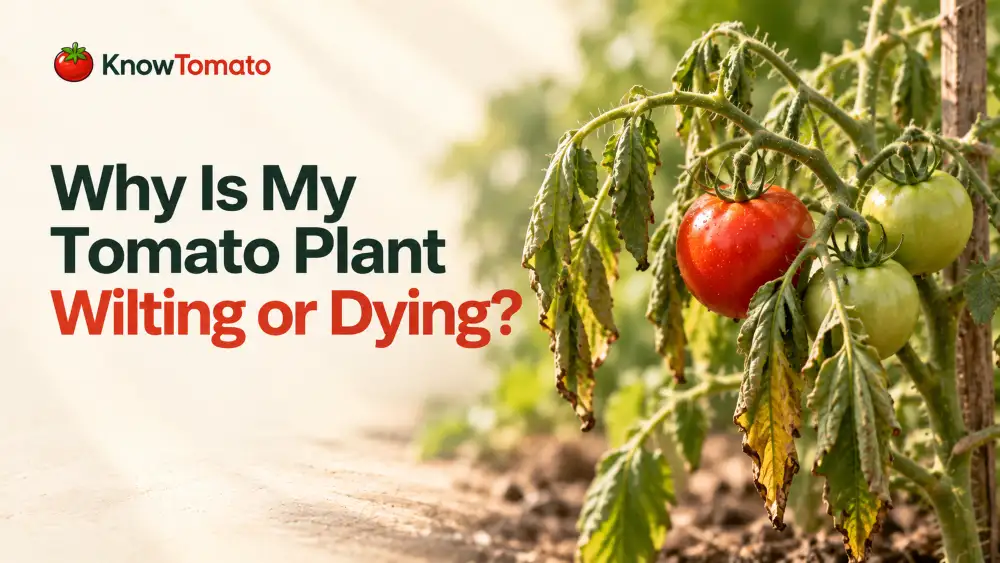
Tomato plant wilting sends a lot of gardeners straight into panic mode, and understandably so. Picture thirteen healthy heirlooms, and one of them wilting overnight while the rest stand fine. That exact case stumped a grower named ladon. It happened seemingly out of nowhere, despite careful watering and a regular fungicide routine.
Not every wilting plant is dying, though. Another grower, AltoPaul, pointed out that plants getting direct afternoon sun wilted during that window. They recovered within two hours once the sun moved past.
This guide sorts tomato wilting by cause. It starts with the reversible ones and moves toward the causes with no real fix. Matching the pattern to the right cause saves a plant that might not actually be dying at all.
The short version
Simple underwatering and heat stress both cause wilting that reverses once conditions improve. Fungal wilts like verticillium and fusarium, by contrast, have no cure once a plant shows symptoms.
Tomato spotted wilt virus spreads through thrips and has no cure either. Resistant varieties and reflective mulch reduce the risk, though.
Walnut trees poison nearby tomatoes through a compound called juglone. Stalk borers tunnel into stems in a way most insecticides cannot reach.
Overfertilization and root stress can mimic disease closely enough to fool an experienced gardener. University of Nebraska Lincoln Extension covers most of these causes directly. This guide builds on that foundation with real cases from other sources.
Simple underwatering
The most common cause is also the easiest to fix. University of Nebraska Lincoln Extension notes tomato plants wilting in dry conditions typically recover quickly once watered.
Roughly one inch of water per week keeps most plants from reaching that stress point. Applying it at the soil base rather than overhead helps too.
Morning watering matters if overhead sprinklers are the only option. Wet foliage overnight invites disease problems of its own.
Heat stress that looks worse than it is
Not every wilting plant needs intervention at all. The Houzz forum contributor AltoPaul described a telling pattern on a planting getting strong direct sun.
Plants wilted only during peak sun exposure and recovered within about two hours once that direct light passed. Some tomatoes thrive with a bit of filtered shade, particularly in intense summer heat. A temporary screen can reduce that daily wilt and recovery cycle.
The key distinguishing sign is recovery. A plant that perks back up on its own within a few hours is behaving very differently. One showing a disease with no cure never bounces back that fast.
Fungal wilts with no cure
Verticillium and fusarium wilt are the two fungal diseases most responsible for wilt that never fully recovers. University of Nebraska Lincoln Extension describes leaves wilting during the day and recovering at night at first. Eventually, infected plants stop recovering at all.
Cutting into the stem reveals the diagnostic sign either disease leaves behind. Brown streaking inside the vascular tissue confirms a fungal wilt is at work. No treatment reverses it once that streaking appears.
Resistant varieties marked with a V or F on their tag indicate breeding against one or both fungi. Some carry both letters together. This site’s dedicated guides to verticillium wilt and fusarium wilt cover the differences in far more depth.
Tomato spotted wilt virus
A virus explains some wilting cases extension sources rarely get asked about directly. NC State Extension describes bronzing and small brown lesions on tomato foliage. Yellow ringspots and sunken brown patches show up on the fruit too.
Seedlings infected early can develop a distorted, hooked growth pattern. Extension sources call it a shepherd’s crook, and it is often followed by death.
Thrips spread the virus. They acquire it as larvae feeding on one infected plant. Adults then transmit it to the next plant they visit.
Insecticides only partially reduce spread, and NC State Extension explains why. Thrips transmit the virus mainly while feeding inside flowers. Insecticide coverage there is far less effective than it is on foliage.
Reflective mulch has proven more effective than standard black or white plastic at reducing thrips populations on tomatoes. Varieties carrying the Sw-5 resistance gene offer real protection too. Removing weeds like dandelion and sow thistle cuts down on alternate hosts nearby.
Any symptomatic plant should be pulled once spotted, since no treatment cures an infected plant.
Walnut toxicity
A tomato planted too close to a black walnut tree faces a threat with no product based fix at all. This site’s companion planting guide covers the juglone toxicity mechanism in full. It also covers the two year waiting period recommended after a walnut tree is removed.
Nothing saves a plant already showing stunted growth and wilting from juglone exposure. Moving future plantings well beyond the tree’s dripline is the only real prevention.
Stalk borers
A single wilting stem, rather than a whole plant collapsing at once, points toward a pest working from the inside out. Virginia Cooperative Extension describes stalk borer larvae boring into the stem. The entrance hole they leave can measure up to a quarter inch across.
The center of an infested plant can die back while the rest continues limping along. Splitting the stalk just above that entrance hole lets a gardener physically locate and remove the larva by hand.
Virginia Cooperative Extension is direct about a genuine limitation here. No effective insecticides exist for stalk borer control in home gardens. That makes weed management the more useful long term strategy.
Mowing or destroying large stemmed weeds around a garden bed removes that habitat early. Stalk borers never get the chance to reach a tomato plant at all.
Overfertilization and root stress
Sometimes wilting has nothing to do with disease or pests at all. A gardener known as lexiegurl09 described new growth turning wilted and dark green. It followed an application of a soluble tomato fertilizer at three quarters strength.
A neighboring bed treated identically showed no problems, which pointed away from a garden wide issue. That gardener tested for bacterial wilt too, cutting a sucker and checking for a telltale white, stringy discharge in water. None turned up.
A cutting from the affected plant, placed in fresh potting soil, looked notably better within three days. That kind of fast improvement points toward fertilizer or root stress. An incurable disease would not turn around that quickly.
Frequently asked questions
Will a wilted tomato plant recover if I water it?
Often, yes, if underwatering is the actual cause. A plant that perks back up within hours of watering, or after direct sun passes, is showing stress. That is not the same as a disease with no cure.
How can I tell if my tomato plant has a fungal wilt disease?
Cut into the stem near the soil line. Brown streaking inside the vascular tissue confirms verticillium or fusarium wilt. Neither has a cure once that sign appears.
Can overwatering cause a tomato plant to wilt too?
Yes. Waterlogged roots lose the ability to take up water properly, which can look identical to drought stress from the outside. A soil check before watering again helps rule this out.
Is there any treatment for tomato spotted wilt virus?
No. Infected plants should be removed. Prevention relies on resistant varieties, reflective mulch to reduce thrips, and clearing nearby weed hosts.
Why did only one of my tomato plants wilt when the others look fine?
That pattern often points toward a localized cause on that one plant. A stalk borer, root damage, or overfertilization are more likely than a disease spreading through the whole bed. Checking the stem for an entrance hole or brown streaking helps narrow it down.
The bottom line: tomato plant wilting has real, distinct causes, and only some of them are worth panicking over. Simple water stress and heat stress both reverse on their own. Fungal wilts, spotted wilt virus, and walnut toxicity do not. For the two fungal wilts covered in full depth, see our verticillium wilt tomato guide and our fusarium wilt tomato guide. For the walnut tree connection, see our what not to plant with tomatoes guide. For the complete disease lineup this guide fits into, see our tomato diseases guide.
SOURCES
University of Nebraska Lincoln Extension: Possible Causes of Sudden Wilt and Death in Tomatoes. https://lancaster.unl.edu/possible-causes-sudden-wilt-and-death-tomatoes/
NC State Extension Publications: Tomato Spotted Wilt Virus on Tomato and Pepper. https://content.ces.ncsu.edu/tomato-spotted-wilt-virus-on-tomato-and-pepper
Virginia Cooperative Extension: Stalk Borer. https://www.pubs.ext.vt.edu/3104/3104-1567/3104-1567.html