
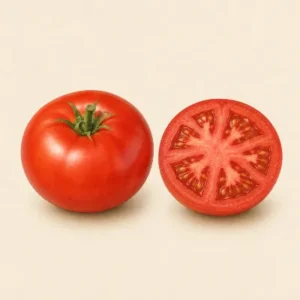
Jet Star Tomato
Jet Star tomato offers medium red slicing fruit on an indeterminate vine, with crack resistance claims that still need sensible watering.
Flavor & performance
The honest verdict
What's great
- Medium fruit suits everyday slicing
- Smooth fruit emphasized by suppliers
- Crack resistance is a catalog strength
- Indeterminate habit extends harvest
- Established variety sold by several suppliers
Watch out for
- F1 seed does not preserve identical offspring
- VF does not cover every tomato disease
- Cracking can still follow moisture swings
- Needs support despite compact descriptions
- Mild flavor is not everyone's preference
Grow it in your zone
| Trait | Jet Star Tomato | Celebrity | Better Boy |
|---|---|---|---|
| Habit | Indeterminate | Determinate or semi determinate | Indeterminate |
| Fruit | About 6 to 8 oz | About 8 oz | Generally larger slicer |
| Timing | About 70 to 72 days | About 70 to 75 days | About 75 days |
| Use | Fresh slicing | Fresh slicing | Large slices |
| Disease codes | VF | V, F1, F2, TMV, N | Confirm VFN packet details |
| Seed saving | F1 offspring vary | F1 offspring vary | F1 offspring vary |
Jet Star tomato is a red slicing hybrid for gardeners who want a continuing harvest from an indeterminate plant. Its useful distinction is smooth, relatively crack resistant fruit at an ordinary sandwich size. Compact growth in a catalog does not mean a small patio plant.
Plan around fruit of roughly six to eight ounces and about 70 to 72 days from transplant under suitable conditions. Those are catalog expectations, not a deadline or a yield guarantee. The strongest reasons to choose it are its fruit type and manageable picking size, rather than an unqualified promise of disease resistance.
What the Jet Star tomato record supports
Harris describes a vigorous indeterminate vine, smooth globe shaped fruit and an early to middle harvest. Other seed listings describe a relatively compact indeterminate habit. Both can be true: a vine can be shorter than another indeterminate without ending growth like a determinate.
Current supplier figures also explain a size discrepancy in older descriptions. Holmes lists six to eight ounce fruit; Fedco describes seven to eight ounce globes. A one pound specimen is possible in many slicers, but it should not be advertised as this variety’s usual fruit.
For maturity, listings around 70 to 72 days are closely aligned. Count that from transplanting, not from sowing seed. Cool establishment weather, transplant stress and poor light can delay harvest beyond the printed figure.
The variety has a long commercial history, but longevity is not a controlled performance trial. Supplier accounts refer to its success in an older Harris catalog. That supports an established reputation without proving every claim repeated about its launch or its performance in every climate.
Flavor, texture and the low acid label
Catalog descriptions emphasize pleasant, mild flavor and smooth fruit. That makes Jet Star worth considering when you prefer a gentler red slicer. Flavor judgments remain personal and can change with ripeness, weather and growing conditions.
Do not turn mild into a laboratory measurement. A sweet tasting tomato can still be acidic. The balance of sugars, acids and aroma affects what you taste, while pH and total acidity answer different questions.
Harris uses low acid wording and explicitly tells canners to add lemon juice. That is a useful caution, not evidence that a particular homegrown batch has a known pH. No batch measurements were supplied for this profile.
Nor does the label show that Jet Star is easy on the stomach. A flavor preference is different from a claim about reflux or another health condition. This is a food and garden choice, not a treatment recommendation.
For preserving, follow a tested tomato recipe and its acidification directions. Do not remove the acid because a fruit tastes sharp, or add an improvised amount because it tastes mild. The tomato canning guide explains where the tested procedure matters.
Disease resistance: read VF narrowly
Jet Star is sold with VF resistance, referring to Verticillium and Fusarium wilt. Confirm the codes on the actual seed packet or transplant label. Supplier abbreviations can omit race details that matter in an affected garden.
VF does not mean protection from early blight, Septoria leaf spot, late blight or every root problem. It also does not establish root knot nematode resistance. Resistance limits a specified problem under specified conditions; it is not immunity.
If last year’s tomatoes wilted, identify the cause before choosing a replacement. Drought, damaged roots and several pathogens can produce similar symptoms. A variety selected for the wrong disease cannot solve the underlying problem.
Mulch, support and watering at soil level help reduce soil splash and wet foliage. They complement resistance rather than replacing diagnosis. Use the tomato disease guide when symptoms do not fit the packet’s protection.
Starting and planting Jet Star
Start seed indoors roughly six to eight weeks before your intended outdoor transplant date. That date should follow local frost risk and allow soil to warm. Starting too early can leave you managing oversized plants before the garden is ready.
Use a clean seed starting medium and provide strong light once seedlings emerge. Follow the light manufacturer’s distance guidance rather than holding every LED two inches above the leaves. Fixtures vary too much for one universal hanging height.
Harden plants gradually before moving them outside permanently. Increase exposure to sun and wind over about a week. A healthy plant acclimated to outdoor conditions is more useful than a tall seedling forced ahead indoors.
Choose a sunny location with drainage and enough space for the support system. Six or more hours of direct sunlight is a common minimum; more can improve the available growing light. Local heat and water conditions still shape the best site.
Spacing depends on whether you use a cage, stakes or a trained trellis. A caged plant usually needs more lateral room than a carefully trained stem. Follow your regional guidance and leave enough access to inspect and harvest the lower canopy.
Water and feeding without a fixed fertilizer calendar
Keep root zone moisture reasonably even, particularly while fruit is enlarging. Check the soil beneath the surface rather than judging from a dry crust. Rainfall, soil texture, mulch and plant size all change how often irrigation is needed.
A weekly rainfall estimate can help plan outdoor watering, but it is not a daily dose for every plant. A container may dry much faster than a mulched garden bed. Water at the base and allow the root zone to drain.
Use a soil test to guide amendments in a garden bed. Apply fertilizer at its labeled rate and account for nutrients already present. Automatically feeding every two weeks can oversupply nutrients in a fertile bed.
Blossom end rot is a calcium supply problem within developing fruit, often associated with water and root stress. It does not automatically mean the soil needs lime. Check moisture, roots and soil results before adding more minerals.
Affected fruit will not heal. The goal is healthier later fruit through steadier growing conditions. The separate blossom end rot explanation helps distinguish that problem from a spreading disease.
Support, pruning and crack prevention
Install a cage, stake or trellis while the plant is young. Size the support for an indeterminate vine and anchor it against wind. The word compact should not persuade you to leave a fruiting plant unsupported.
Prune to fit the support, rather than following a rule that every Jet Star needs exactly three stems. Staked plants need more training than roomy caged plants. Removing excessive foliage can reduce yield and expose fruit to sunscald.
Keep leaves from lying on soil, inspect the lower canopy and remove diseased material appropriately. Avoid stripping healthy foliage merely to create a bare lower foot. Leaf removal cannot cure a systemic wilt disease.
Crack resistance is a useful trait, but sudden water uptake can still split fruit. Avoid letting the root zone become severely dry before heavy watering. Harvest ripe fruit regularly and inspect it after storms.
Cracks also create an opening for deterioration. Do not include moldy or spoiled tomatoes in preserves. For a fresh kitchen harvest, assess damaged fruit promptly instead of assuming every split is only cosmetic.
Is Jet Star suitable for a container?
It can grow in a large container with drainage and an anchored support. It is less forgiving than a compact determinate or dwarf when root space is limited. Water access becomes a practical deciding factor.
A tiny ornamental pot is a poor match for a continuing crop on a vigorous vine. Use a container intended for a full size tomato and check moisture frequently in hot weather. Potting mix and fertilizer directions matter as much as nominal gallon capacity.
If you cannot check it regularly during summer, choose a larger root volume or a smaller plant. A dry container can lose flowers or develop fruit disorders before its foliage looks badly damaged. See growing tomatoes in pots for the complete container setup.
Jet Star versus Celebrity and Better Boy
Celebrity offers a more limited plant height and a broader documented resistance package. It is often sold as determinate, with some descriptions calling its extended production semi determinate. Do not reduce the choice to a promise that Celebrity fruits once and Jet Star fruits forever.
Better Boy is another indeterminate hybrid, generally chosen for larger slicing fruit. Its documented resistance package includes root knot nematodes. That can be relevant after a confirmed diagnosis, but does not make it an automatic upgrade for every garden.
Choose Jet Star if medium slicing size and its advertised crack resistance match your needs. Choose Celebrity when a shorter supported plant is the stronger constraint. Consider Better Boy when larger fruit and its particular resistance traits solve an actual problem.
None of those choices guarantees more pounds in your soil. Compare packet details, available space and what went wrong previously. A useful variety comparison starts with those constraints rather than a universal winner.
Seed saving and next season
Jet Star is an F1 hybrid. You can physically save and germinate its seed, but the offspring may differ in fruit, growth and other traits. Saving it does not preserve a dependable copy of Jet Star.
Buy seed of the named hybrid again when consistency is the goal. If experimentation is the goal, label saved seed as offspring rather than selling or sharing it as the original variety. That distinction keeps the variety name useful.
Frequently asked questions
Is Jet Star tomato determinate?
No. The seed suppliers checked identify it as indeterminate. A relatively compact vine still needs suitable support.
How big are Jet Star tomatoes?
Expect roughly six to eight ounces as a practical catalog range. Some suppliers describe seven to eight ounces. Individual fruit will vary.
How long does Jet Star take to ripen?
Listings commonly give about 70 to 72 days from transplant. Weather and establishment can move that date. It is not a count from sowing seed.
Does low acid mean it needs no acid for canning?
No. Follow the tested recipe’s acidification directions. Flavor wording cannot establish a jar’s safe acidity.
Can I save seed from Jet Star tomato?
Yes for experimentation, but its F1 offspring may not resemble the original plant. Buy the named hybrid again if you need predictable Jet Star traits.
Harris Seeds: Tomato Jet Star F1 Seed, current cultivar description and 72 day maturity. https://www.harrisseeds.com/products/tomato-jet-star-f1-seed
Holmes Seed Company: Jet Star F1, fruit size and hybrid habit. https://www.holmesseed.com/jet-star-f1/
Fedco Seeds: Jet Star Slicing Tomato, catalog history and fruit description. https://fedcoseeds.com/seeds/jet-star-slicing-tomato-4233
Totally Tomatoes: 2021 catalog, Jet Star Hybrid VF resistance listing. https://www.totallytomato.com/downloads/2021TTcombinedpdf.pdf
National Center for Home Food Preservation: Canning Tomatoes Introduction, acidification and fruit selection. https://nchfp.uga.edu/how/can/how-do-i-can-tomatoes/canning-tomatoes-introduction/
University of Minnesota Extension: Growing Tomatoes in Home Gardens, light, moisture and disorders. https://extension.umn.edu/garden-and-home/yard-and-garden/gardening-in-minnesota/growing-tomatoes
University of Maryland Extension: Growing Tomatoes in a Home Garden, site, training and fertility. https://www.extension.umd.edu/resource/growing-tomatoes-home-garden
Iowa State University Extension: Growing Tomatoes in Containers, root space and care. https://yardandgarden.extension.iastate.edu/how-to/growing-tomatoes-containers
All America Selections: Tomato Celebrity hybrid, maturity and resistance record. https://all-americaselections.org/product/tomato-celebrity-hybrid/
All America Selections: AAS Winning Tomato Types, Celebrity growth habit nuance. https://all-americaselections.org/aas-winning-tomato-types/
Seminis/Bayer: Better Boy, breeder variety details. https://www.vegetables.bayer.com/us/en-us/seminis-products/tomato/details.html/tomato_better_boy_usa_seminis_home_garden_home_garden_all.html
Grower's Picks for Jet Star
Start with the equipment you already have. These options match the plant size and uses described above; choose what fits your growing setup.
As an Amazon Associate I earn from qualifying purchases. Affiliate disclosure. Check the selected size, contents and current availability before ordering.
Garden support stakes
For training and tying upright stems. Install early and use soft ties with room for growth.
Check usable height after insertion. Larger vines may need a taller or reinforced framework.
Check options on AmazonRain Bird garden drip kit
Useful for a bed or several plants where you want watering directed to the root zone.
Check faucet, pressure and fitting requirements. Adjust watering to the soil; one pot may be easier to water by hand.
Check options on AmazonEspoma Tomato-tone
A granular feeding option when your soil or potting mix needs nutrients. Follow the label and account for existing fertilizer.
Extra fertilizer is not a cure for blossom end rot. Check moisture and soil conditions first.
Check options on AmazonEZ-Straw seeding mulch
An optional bed mulch to reduce evaporation and soil splash. Keep it away from direct contact with stems.
Check the selected product and additives. Use suitable mulch you already have instead of buying a bale for one pot.
Check options on Amazon